
The Living Cosmos
Jeffrey Meyers
D.H. Lawrence’s Etruscan Places (posthumously published in 1932), propelled me to the tombs carved out of volcanic rock. The dying author ecstatically wrote:
To the Etruscans all was alive; the whole universe lived; and the business of man was himself to live amid it all. He had to draw life into himself, out of the wandering huge vitalities of the world. The cosmos was alive, like a vast creature. The whole thing breathed and stirred. Every man, every creature and tree and lake and mountain and stream, was animate, had its own peculiar consciousness.
It was thrilling, decades ago, to descend into the dark Etruscan cave in Tarquinia, flick on the light and see the dancing creatures on the wall paintings magically spring to life. (Visitors today must observe the art through a plastic partition that blocks the way to the inner room.). As an Indian friend said of the Moghuls, “Those Etruscans, they knew how to live.”
The Etruscans lived from the 9th to the 2nd century BCE and had a small population of about 200,000. They were gradually invaded, conquered and absorbed into the Roman Empire and disappeared from the face of the earth. No one knows the mysterious origin of their non-Indo-European language, which adapted the Greek alphabet for its writing and resembles the strange speech that Gulliver hears on his travels. One letter, samekh, looks like a little four-paneled window. Apart from a few funereal terms and god-names—the fluffy Fufluns is Dionysos—no one knows what the language means. The tongue is now extinct and has no modern descendants. When the Etruscans tried to communicate with the deities, they “used the liver of a sacrificed animal to divine the will of the gods,” but often came up with an opaque response.
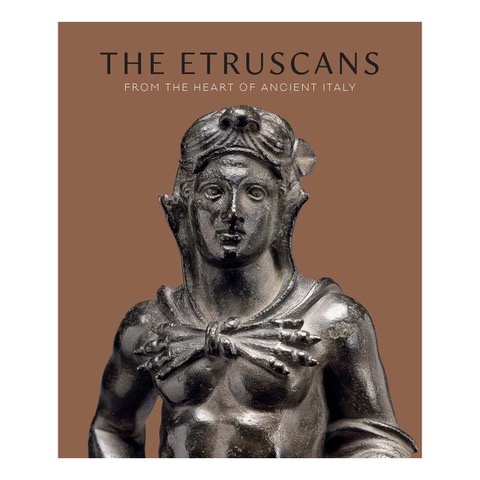
The handsome exhibition in the San Francisco Legion of Honor, The Etruscans: From the Heart of Ancient Italy (edited by Renée Dreyfus and Louise Chu, Yale University Press, 384p, $75) takes place from May 2 to September 20, 2026 before moving on to San Antonio, Texas. It contains nearly 200 mostly sacred items including sculpture, vessels, engraved mirrors, embossed gold jewelry, a calendar, a single preserved text written with brush and ink on linen that was later used to wrap an Egyptian mummy, even a ceremonial shovel and a decorated ostrich egg. The animated animalistic art portrays a dragon, chimera, griffin, sphinx, lion, leopard, horse, fawn, cat, ibis and snake.
This handsome and impressive catalogue, folio-size with double columns of small print, is reader-unfriendly. It weighs 5 pounds and could be frequently lifted instead of going to the gym. It contains 25 mercifully short scholarly essays that appeal only to a learned and limited audience. The inscriptions are obscure—“Youth with a krotalum dancing on a table (part of a thymiaterion)” and “Intertwined archlets and palmettes, and guilloche edging on a situla, plique-à-jour.”
Several scholars complain that understanding Etruscan culture, which remains largely unknown, is a difficult and daunting task. But the catalogue cries out for more precise descriptions of the major works of art. The Attenuated Statue of Priestess Holding Serpent is an elongated work of a severe-faced woman, gripping a penile snake, who looks like the gaunt, razor-thin sculpture of Alberto Giacometti. The two-and-a-half-foot bronze Chimera, with open jaws and spiky mane, crouches with his serpentine tail curled back over his hind quarters while a beaked and horned goat rides fiercely on his back.
There’s a lot of violence in the images of these aesthetic people. The bulging Water Jar is encircled by a vine with heart-shaped leaves. Two armed and armored men, with a knife and an axe, grab the necks and attack two of the ten-headed decapus—a thin-bearded, tongue-lashing, monster snake. The central orange man on the Red-Figure Storage Jar, dressed in a helmet and flowing cloak, hurls a spear while riding on a thick-maned, wide-eyed prancing horse. He’s attended by a bearded man with an axe, and by a woman in profile. She touches the horse’s wavy tail and bids farewell to the man as he goes off to war. These two figures are charmingly bent along the curved edges of the jar.
Facing forward and reclining on the dark terracotta Sarcophagus of the Spouses, itself supported by carved legs, a long-haired, square-bearded, bare-chested muscular man affectionately embraces and holds hands with his handsome, smiling, long-braided, robed but bare-bosomed wife. Edgar Degas’ etching Mary Cassatt at the Louvre (1880) shows her gazing intently at the huge terra-cotta figures in an Etruscan tomb from Cerveteri (c.500 BCE). The enigmatically smiling husband and wife, reclining on top of a sarcophagus and enclosed in a glass case, face the fashionably dressed Cassatt who leans on a thin umbrella. The strange atmosphere gives these figures an air of permanent tranquility.
In Banquet Scene on Back Wall two crouching leopards above the everlasting banquet face each other a with fierce open jaws, extended tongues, sharp front claws and long tails marked by small brown-and-white squares. Dancers, musicians and servants perform for the three reclining couples, who drink and dine while preparing to continue their pleasures in the afterlife. The Etruscans had joie de mourir as well as joie de vivre. On the back wall of the Tomb of the Shields a bearded, bare-chested, bright-eyed, spike-haired, seated man offers food with an extended arm to an elegantly coiffed, rosy-cheeked woman, wearing a necklace and shawl, and seen in profile. The table in front of them is laden with bread and fruit; the wall behind them has a long inscrutable inscription; and a pretty little pale blond girl standing next to the woman circulates the cool air with a long-handled fan.
We can learn a valuable lesson today from the “celebrated speech of the Emperor Claudius, granting citizenship to the Gauls in CE 48, which praised the openness of Roman and Etruscan society when foreigners were welcomed and integrated even with the highest honors ‘for the greater good of the State.’ ”
Jeffrey Meyers has published D. H. Lawrence and the Experience of Italy, D. H. Lawrence and Tradition, The Legacy of D.H. Lawrence and D. H. Lawrence: A Biography.






Be First to Comment