
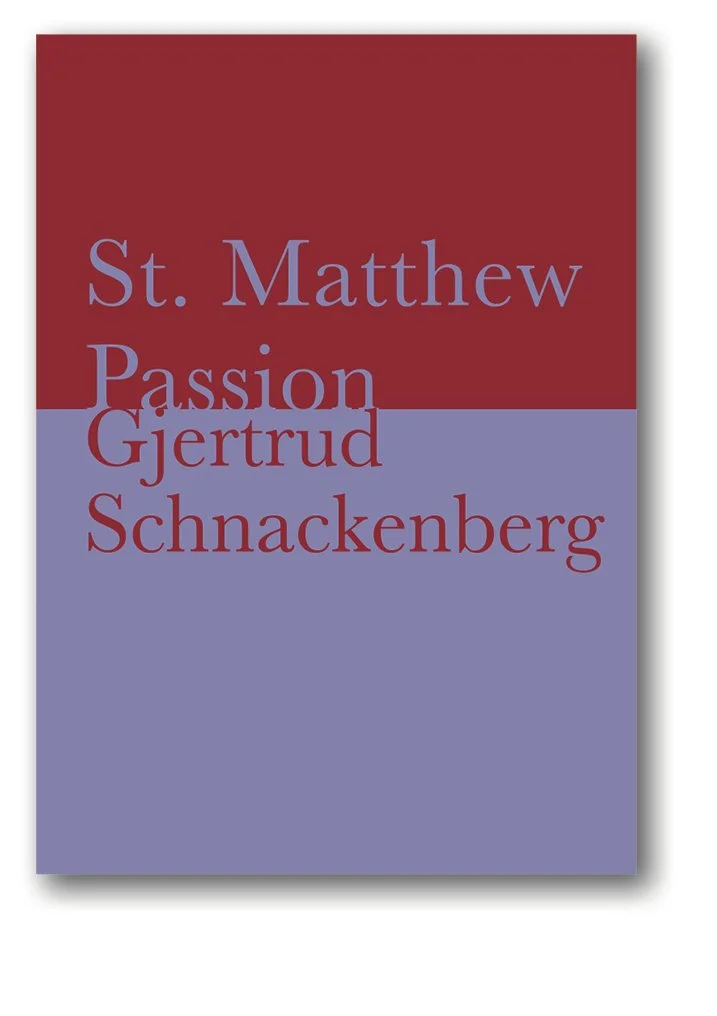
St. Matthew Passion
by Jeffrey Meyers
Gjertrud Schnackenberg’s St. Matthew Passion (Medford, MA.: Arrowsmith, 2024, 93p, $18 pb) is her first book since 2010. It’s unclear why so many years have passed between the appearance of her work. The long delay could have been caused by illness, depression, writer’s block or a feeling that she could not live up to all the prizes and awards she had won, and could no longer fulfill her early promise.
It’s also unclear why she published her long poem “Afghan Girl” in the New England Review (2017), or why she left the prestigious publisher Farrar Straus Giroux for the low-profile Arrowsmith Press. The change might have been prompted by a personal quarrel, long silence between books, or her retreat into more difficult and ornate mythology, philosophy and Classics in The Throne of Labdacus (2000).
Bach’s St. Matthew Passion, 1727 (2 hours and 45 minutes), is a sacred oratorio for solo voices, double choir and double orchestra, with a libretto by Picander. One critic called it “the most monumental of all Bach’s works.” It is based on the Gospel of St. Matthew, chapters 26 and 27, on the trial, crucifixion, death and burial of Christ, among the most dramatic and tragic chapters in the New Testament. Matthew contains many famous phrases in the King James Bible: “let this cup pass from me”; “the spirit indeed is willing, but the flesh is weak”; “they that take the sword shall perish with the sword”; “My God, my God, why hast thou forsaken me?”
During an online interview with her Farrar Straus editor Jonathan Galassi, Schnackenberg (whom I’ll call GS) suggested the healing power of music: “In the darkest place, my music recalls itself to me.” The 8-part, 52-page poem about her favorite piece of music is narrated in the first person, with unrhymed triplets and uneven lines. She includes many German words from the libretto and many literary quotations, including three by Rainer Maria Rilke. Bach wrote his music on Matthew; GS wrote her words on Bach. The poem describes how “the upheavals in the music” surge in her, how her responsive “heart’s leap” subtly suggests the graceful jump of a hart.
Thomas Mann and Elizabeth Bishop have also accepted the challenge to write about music, in fiction and poetry. In his novel Doctor Faustus: The Life of the German Composer Adrian Leverkühn (1947), Mann creates convincing verbal descriptions of the works of real composers and of Adrian’s fictional compositions. Mann writes technically and lyrically about Beethoven’s unfinished Piano Sonata #32, Opus 111 (1822): “The characteristic of the movement of course is the wide gap between bass and treble, between the right and the left hand, and a moment comes, an utterly extreme situation, when the poor little motif seems to hover alone and forsaken above a giddy yawning abyss.” Mann uses Adrian’s demonically inspired dissonant music to symbolize Germany’s descent into social chaos and Nazism.
Elizabeth Bishop’s extremely accomplished “I Am In Need Of Music” (1928), written while she was still a student, anticipates the works of GS by describing the effect of music on her feelings, on its power to heal and purify:
I am in need of music that would flow
Over my fretful, feeling fingertips,
Over my bitter-tainted, trembling lips,
With melody, deep, clear, and liquid-slow.
Oh, for the healing swaying, old and low,
Of some song sung to rest the tired dead,
A song to fall like water on my head,
And over quivering limbs, dream flushed to glow!
GS’s St. Matthew Passion opens dramatically when she’s about to leave her house on inconsequential errands and realizes that she’s left a recording of Bach’s music still playing. The sounds draw her back into Bach’s world: “I try to pull away, but can’t, / My coat drawn halfway on / And hanging crossways in the back.” “Hanging crossways” suggests that she identifies with the crucifixion. Later on, a splinter of music “pierces” her like the spear in Christ’s chest. In her most stunning triplet, which rhymes internally and descends from the forbidding sky to Christ’s head and chest, “a cold red sun / Was nailed to the West, and Jesu’s head / Was hanging on his breast.”

Strong autobiographical elements enhance the interest of her poem. Her description of Bach as a “Stalwart, barrel-chested, bedrock Lutheran” recalls the portrayal of her adored father, a professor at Pacific Lutheran University, in her first book Portraits and Elegies (1982). Alluding to her grief after the death in 2002 of her husband, the Harvard philosopher Robert Nozick, she writes of his “leavetaking that no one / Would have wished for. / Wanted, willed. . . . A gathering in memory / Of the severe damage / To a human heart.”
The biographical passages on Bach balance the abstract accounts of his music. She doesn’t mention his amazing 20 children, but describes the workshops and builders of his
musical instruments in Leipzig. In a sensual passage, the musicians play their instruments like a kiss, “The way a tongue will touch, / Draw back, / Then touch again.” GS was rumored to have serious eye problems and may have included the last poem, “Cataract Surgery, 1750,” for personal reasons. She refers to but doesn’t fully explain Bach’s disastrous eye operation, which blinded him and hastened his death that year. In the most important triplet of the poem, Bach himself explains that he creates music in the same way that GS creates poetry: “ ‘Ceaseless work, analysis, reflection, / writing much, and endless self-correction, / that is my secret.’ ”
At the end of GS’ St. Matthew Passion she returns to her room at the beginning of the poem. Rilke’s epigraph on spiritual insight, Put out my eyes, and I can see you still, takes on new visual meaning in the context of Bach’s blindness. Finishing her poem, she quotes Christ’s final words on the Cross, “It’s finished” (consummatum est). Yet the high-strung poet is rivetted to her room. Unwilling and unable to depart—“I have to leave . . . My footstep stalls, midair, unable to”—she’s still captivated and captured by the sacred music.
Jeffrey Meyers has published Manic Power: Robert Lowell and His Circle (1987), Robert Frost: A Biography (1996) and Robert Lowell in Love (2016). The Biographer’s Quest appeared with Mercer University Press in April 2026.


Be First to Comment