
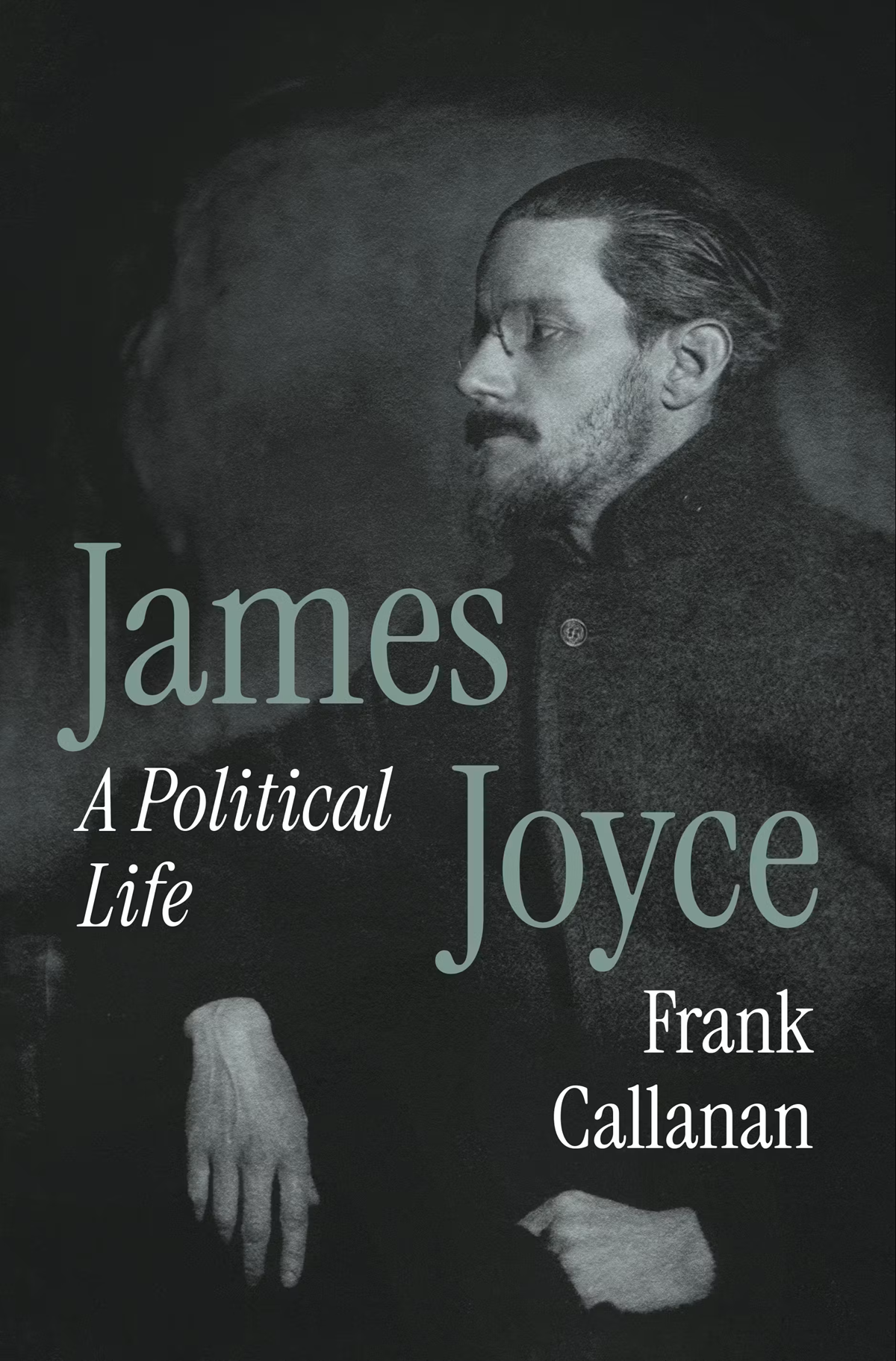
Joyce’s Politics
by Jeffrey Meyers
Frank Callanan (1956-2021) was a learned Irish barrister and Joyce scholar, but during his 20 long years of writing James Joyce: A Political Life (Princeton, 2026, 909p, $45) he lost control of the massive enterprise. Instead of following the cardinal rule of biography—the author must concentrate on his reader’s interest rather than on his own obsessions— he threw in everything he’d found. His four editors, including his widow, are too reverential about his long-winded and repetitive, often irrelevant and rather dull text. They mistakenly state there was “little need for deletion,” though his book covers only the first part of Joyce’s life through his exile in Trieste in 1915 and could have profitably been cut in half. The 108-page chapters on Joyce’s father and his father’s four friends, for example, should have been deleted.
Callanan’s book ranges from simple-minded statements, “The titles of all the stories in Dubliners are carefully chosen,” to convoluted style, “It was an early instance of Joyce’s invocation of the contingencies of absence which derived from the strategising of his exile.” One example of useless and boring information, which has nothing to do with Joyce’s politics, is “Peter Stanislaus Little, who is given his real name in Portrait, had died at the age of sixteen, in the small hours of 10 December 1890, apparently of rheumatic fever, reportedly contracted after a drenching on the windswept Bog of Allen, and was buried in the Jesuit cemetery in Clongowes.”
The author includes large chunks of his previous biography, The Parnell Split, 1890-1891 (1992), about the scandalous and disgraced Irish politician who was the main political influence on the young Joyce. Parnell’s Home Rule movement advocated Ireland’s partial self-government and control of its own internal affairs. He was about to pass this bill in the British Parliament in December 1889 when Captain William O’Shea instituted divorce proceedings and named Parnell as co-respondent. Parnell’s long adulterous affair with Kitty O’Shea was exposed, he was reviled, his party split and the bill was defeated. This book does not include a photo of Kitty O’Shea, who (like the Duchess of Windsor who ruined Edward VIII’s chance to remain king) was no great beauty. Parnell’s story, which runs through the whole book, could have been told in a concise chapter.
Despite his obsessive focus on Parnell, Callanan doesn’t see the essential personal reasons why Joyce loyally defended and vindicated him. Joyce was anti-Catholic, Parnell was brought down by the Catholic Church. Like Parnell, Joyce was an exile, a sexual sinner condemned for his immoral behavior when he fled Dublin with the unmarried Nora Barnacle in 1904. (His father wittily predicted that Barnacle would always stick to him.) As Joyce wrote to his father about Parnell: “I was very fond of him always, being a sinner myself, and even liked his faults.”
Callanan argues that Parnell’s downfall influenced Joyce’s treatment of Ireland in his writing, and his themes of doubt, betrayal, political and social injustice. He claims that “Joyce’s politics and his modelling of history are of a brilliance, originality and coherence that have passed mostly unrecognized.” In fact, his politics have been recognized in many books, most notably in Dominic Manganiello’s Joyce’s Politics (1980). Callanan convincingly calls this book “pioneering and exemplary,” “a valuable thematic account,” “an excellent thematic analysis,” and then plows the same field for more than 900 pages. He does not discuss the importance of Vladimir Lenin, who plotted the Russian Revolution in Zurich in 1916-17 when Joyce also lived in that city. Tom Stoppard’s Travesties (1974) dramatized their time in Zurich.
The author’s leaden academic prose follows familiar ground but does not illuminate the major works, and his mass of information offers only a kernel of insight. He bears like the Turk no rival near the throne and condemns many of his rivals—“Philip Herring could hardly be more wrong”—but does not surpass them. Callanan relies on, but makes fifty mostly negative references to, Richard Ellmann’s superb biography James Joyce (revised edition 1982), which has far greater discoveries and infinitely superior style and insight. Frank O’Connor’s eight lines on “Ivy Day in the Committee Room,” a story in Dubliners (1914) that portrays “the betrayal of everything for which Parnell had stood,” is more perceptive than anything in Callanan’s fifty-page chapter. His references to Ulysses (1922) are scattered throughout the book instead of focused in one chapter; and his discussion of the almost impenetrable Finnegans Wake (1939) weakly concludes: “However distant Joyce held himself from the new Irish state, Irish independence framed the Wake’s treatment of the Irish past and sustained the great Wakean theme of rebirth and renewal.”
Joyce’s political views are well known. His early satiric poem “Gas from a Burner” (1912), he defends his fallen hero:
And in a spirit of Irish fun
Betrayed her leaders, one by one.
’Twas Irish humor, wet and dry,
Flung quicklime into Parnell’s eye.
In the famous Christmas dinner scene in Portrait of the Artist (1916) Simon Dedalus, based on his father and speaking for Joyce, exclaims: “Sons of bitches! When [Parnell] was down they turned on him to betray him and rend him like rats in a sewer.” Callanan calls the Christmas dinner “the most consummately realised dramatic scene in Joyce’s fictional writing,” though “Cyclops” and other stylistically dazzling chapters in Ulysses are far greater.
Callanan’s comments on Leopold Bloom in Ulysses are banal: “The subject of Jews in Europe embraced polarities”; the phrase “ ‘Jewgreek is Greekjew’ brings together many of the themes of Joyce’s life and work.” The conclusion to his 44-page chapter on Ulysses is awkwardly written and obvious: “Born in Ireland, severed from his father’s past as a Jew in Hungary, the assimilated Bloom was at once alive to his Jewishness and daily forced to negotiate or confront the suspicious or overtly hostile characterisation to which he was subject as a Jew in Ireland.” In other words, Bloom was the victim of Irish anti-Semitism.
The four editors admit that though Joyce “lived through the dramas of the early twentieth century he did not comment publicly,” and rarely privately, on these world-shaking political and military events. Yet Callanan insists that “Joyce was a highly political writer in a way that sets him apart from other modernist writers,” even though (he admits) Joyce never intervened in the political domain, “stayed aloof from the practice of politics and did not profess an aptitude for the political.” Wyndham Lewis and Ezra Pound were much more politically (and disastrously) engaged than Joyce. Thomas Mann, Arthur Koestler and Albert Camus had far more political commitment and insight than Joyce.
Jeffrey Meyers, FRSL, has had thirty-three books translated into fourteen languages and seven alphabets, and published on six continents. Forty-Three Ways of Looking at Hemingway came out in November 2025. The Biographer’s Quest appeared with Mercer University Press in April 2026.

Be First to Comment