
Paul Klee: The Walking Line
Jeffrey Meyers
In the 1960s a clever advertisement said, “You don’t have to be Jewish to love Levy’s real Jewish rye,” accompanied by a photo of a smiling American Indian holding a sandwich. Though not Jewish, the Swiss-born Paul Klee (1879-1940) has a major exhibition at the Jewish Museum in New York. The Nazis called Klee a “Degenerate Artist,” libeled him as a “Galician Jew” from Poland, and declared that he was “impossible as a Jew and as a teacher.” In 1933 they banished him from his academic post in Düsseldorf Academy on the Rhine and removed his paintings from all the museums in Germany. Escaping to Bern, Switzerland, the survivor bravely proclaimed, “my brush to my left and my palette to my right, the sky above. So no calamity!”
The exhibition is a success, but the rationale for Klee’s inclusion is weak. The argument that “he might as well have been Jewish, given his particular denunciation by the National Socialists in 1933 in Germany” is not convincing. Many gentile artists, most notably Max Beckmann, were included in the Degenerate Art exhibition in Munich in July 1937, but that certainly did not make them Jewish. Nor, in an absurd comparison, does Klee’s art “evoke an aspect of the midrash, the Jewish mode of interpretation.”
The catalogue by Mason Klein, Paul Klee: Other Possible Worlds (Yale UP, 176p, $50), includes 70 paintings and more than 200 rapid sketches. Emphasizing the 1930s, the last decade of his life, the exhibition runs from March 20 to July 26, 2026. Klee was also an accomplished violinist and cook, and took inspiring trips to Tunisia in 1914 and to Egypt in 1928. In the 1920s he taught at the Bauhaus school, founded by the architect Walter Gropius in Weimar. Klee taught in Düsseldorf from 1931 to 1933, when he safely returned to his native Switzerland. In 1935 he was diagnosed with scleroderma, a hardening of skin tissues that impeded his manual dexterity. Yet in 1939, during a period of remission, he created an astonishing 1,253 works—more than three every day. Klee combined menacing titles with satiric content: Bastard, Child Murder, Barbarian Mercenary, The Deadly Enemy, Mask of Fear, Stricken City, Death and Fire. His art was colorful, fantastic, playful and witty, and he famously said he was always “taking a line for a walk.”
Mason Klein’s style ranges from the vague, “He was greatly aided by his porous reception of, and appeal to, diverse strains of the avant-garde,” to the opaque, “By embracing non-binary thinking, Klee developed a heterogeneous art that functioned more as a sign revealing otherwise invisible cultural phenomena.” But Klein does explain the significance of Klee’s tiny details and incisively analyzes the meaning of his surprisingly serious work. Several errors appear in the text. Defoe’s Robinson Crusoe,1719 (not Stendhal’s The Red and the Black, 1830) was “the first realist novel.” Atlas (not St. Christopher) “carried the weight of the world on his shoulders.” The mythical Cyclops has one eye (not two), so the long comparison of several two- eyed drawings to the Cyclops is completely mistaken.
The exhibition catalogue looks closely at Klee’s major works. Klein writes that the satirical etching Two Men Meet, Each Believing the Other to Be of Higher Rank (1903), depicting “the monarchs Wilhelm II of Germany and Franz Joseph of Austria who were obliged to honor each other despite their political differences, addresses a social world of absurdly false hierarchies and assumptions of superiority.” Each polite but grimacing hunchbacked figure assumes the correct cringe and attempts to bow lower than his adversary.
Klee’s uncharacteristically harsh and caustic, rather than playful and whimsical etching, The Virgin in the Tree (l903), portrays a female St. Simon Stylites, fleeing from worldly temptation to a lofty arboreal refuge. The naked woman’s spindly fingers and thin right arm support her high-coiffed head as she stares furiously at the viewer. Her muscular, heavy-breasted, full-bellied, open-legged white body is twisted around the gnarled branches of a barren serpentine tree. A gaping hole in the trunk juts out between her thick legs and suggests her open sexual organ. Scowling, isolated, trapped on and by the tree, she expresses a perverse flight from sex. In an ironic contrast to the virgin’s severe mood, two lovebirds—next to her left shoulder but ignored by her—perform a tender mating dance.
Klee’s satiric art inspired some of Sylvia Plath’s violent poems. In “Virgin in a Tree,” the ugly spinster on her tortured rack is
ripe and unplucked, ’s
Lain splayed too long in the tortuous boughs: overripe
Now, dour-faced, her fingers
Stiff as twigs, her body woodenly
Askew, she’ll ache and wake
Though doomsday bud.
In Klee’s etching Perseus (The Triumph of Wit Over Suffering), 1904, “wit” stands for intelligence and cunning rather than amusing cleverness. Perseus, the son of Zeus, was favored by the gods who made him invisible, lent him winged feet and gave him a reflecting mirror. Well-equipped to fight, he avoided a direct look at the hideous face, glaring eyes and serpent-entwined hair of the Gorgon Medusa. Sent on a dangerous mission by a rival in love, he escaped transformation into stone and cut off Medusa’s head.
Klee’s burly, even brutish (not godlike) full-faced Perseus has closely cropped hair, low wrinkled forehead, bulging wide-open eyes, sidelong stare, bladelike nose, half-open mouth, jutting chin, heavy beard, muscular neck and thick lips twisting into a strange smile. The floating profile of Medusa, facing the side of his head, has bulbous eyes and flattened nose, with a long-tongued serpent hanging from her hair and drops of blood falling from her severed head. Crowded together in a constricted frame,, Perseus stares out at the viewer while the dead Medusa—next to his left shoulder, like the birds next to the Virgin—now stares directly at him. He may be thinking about her; she may be haunting him.
Plath’s “Perseus” describes him as “the mammoth, lumbering statuary of sorrow” and considers him superior to classical marble images of the heroic Hercules, the writhing Laocoön and the Dying Gaul. She compares Medusa’s Gorgon-grimace to a fetus head and “the beheaded head of a sullen doll, one braid, / A bedraggled snake”; to a hissing asp, a writhing cobra and a vast Anaconda; and likens her to tragically exalted heroines: Sophocles’ Antigone, Racine’s Phèdre and Webster’s Duchess of Malfi. Plath’s Perseus transcends tragedy with cosmic laughter that triumphs over eternal suffering and with sanity that tips the scale into madness:
Gone
In the deep convulsion gripping your face, muscles
And sinews bunched, victorious, as the cosmic
Laugh does away with the unstitching, plaguey wounds
Of an eternal sufferer.
Klee’s imaginative and skillful drawing Absorption (1919), portrays a balding soft rectangular head, widely spaced eyes, narrow nose, full lips, wispy mustache and thin beard. Klein calls it “a self-portrait whose sensory deprivation (eyes closed and without ears) transcends time and space to depict a presumptive erotic fantasy (given the male and female genitalia the eyes, nose and mouth depict).”
The subject of the copper-colored painting, Harlequin on the Bridge (1920), has a pointed cap, oval head, masked eyes and pursed lips. He stands high above a deep murky moat, with a fortified tower and heavy stone wall on the right side, and an urban building on the left. The enigmatic harlequin, a favorite image in modern art, seems undecided about which way to turn and which choice in life to make. Klein adds, “The figure stands on the bridge, resolutely facing forward with his feet apart and arms limp by his side like a marionette, another passive, betwixt and between character the artist favored. He’s enclosed in a protective bell jar-like structure and poised in an intense illumination of an at once spiritual and fiery, smoky light that rises to the top of the Star of David overhead.”
The drawing Child Murder (1933) not only “alludes to the Massacre of the Innocents, a biblical incident of Infanticide in Bethlehem,” but also more significantly to M (1931), the frightening German Expressionist film about a serial killer of children, viciously played by Peter Lorre. Klein doesn’t mention that the painting he calls “the-not-so-special Prizewinning Apple (1934)” has a penis slyly placed at the top of its bulge, a spinal cord down the middle and an anus at the bottom.
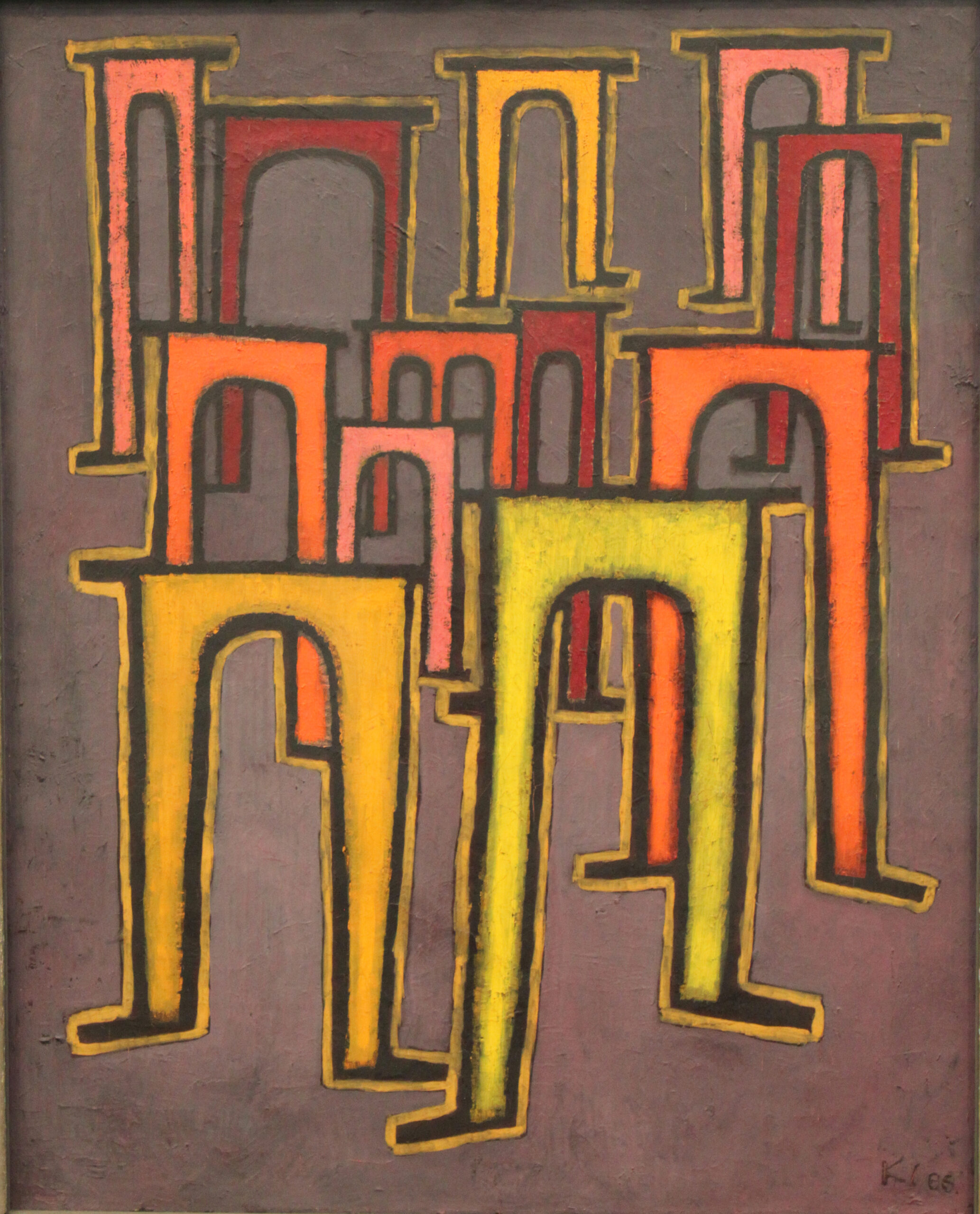
In Klee’s major painting, Revolution of the Viaduct (1937), the figures are headless, mindless and robotic. Klein writes that “the human-footed arches have fallen out of line, a clever critique of Hitler’s military parades and spectacles of power, unity and discipline. Its independent arches robustly break away in a passionate palette of red, orange, yellow and pink” that counter the grey-green, brown and black of the Nazi uniforms. This illuminating exhibition shows that Klee didn’t have to be Jewish to appear in the Jewish Museum.
Jeffrey Meyers has published Painting and the Novel, Impressionist Quartet, biographies of Wyndham Lewis and Modigliani, and a book on the Canadian realist painter Alex Colville.


Be First to Comment