
Lost Generation
Jeffrey Meyers
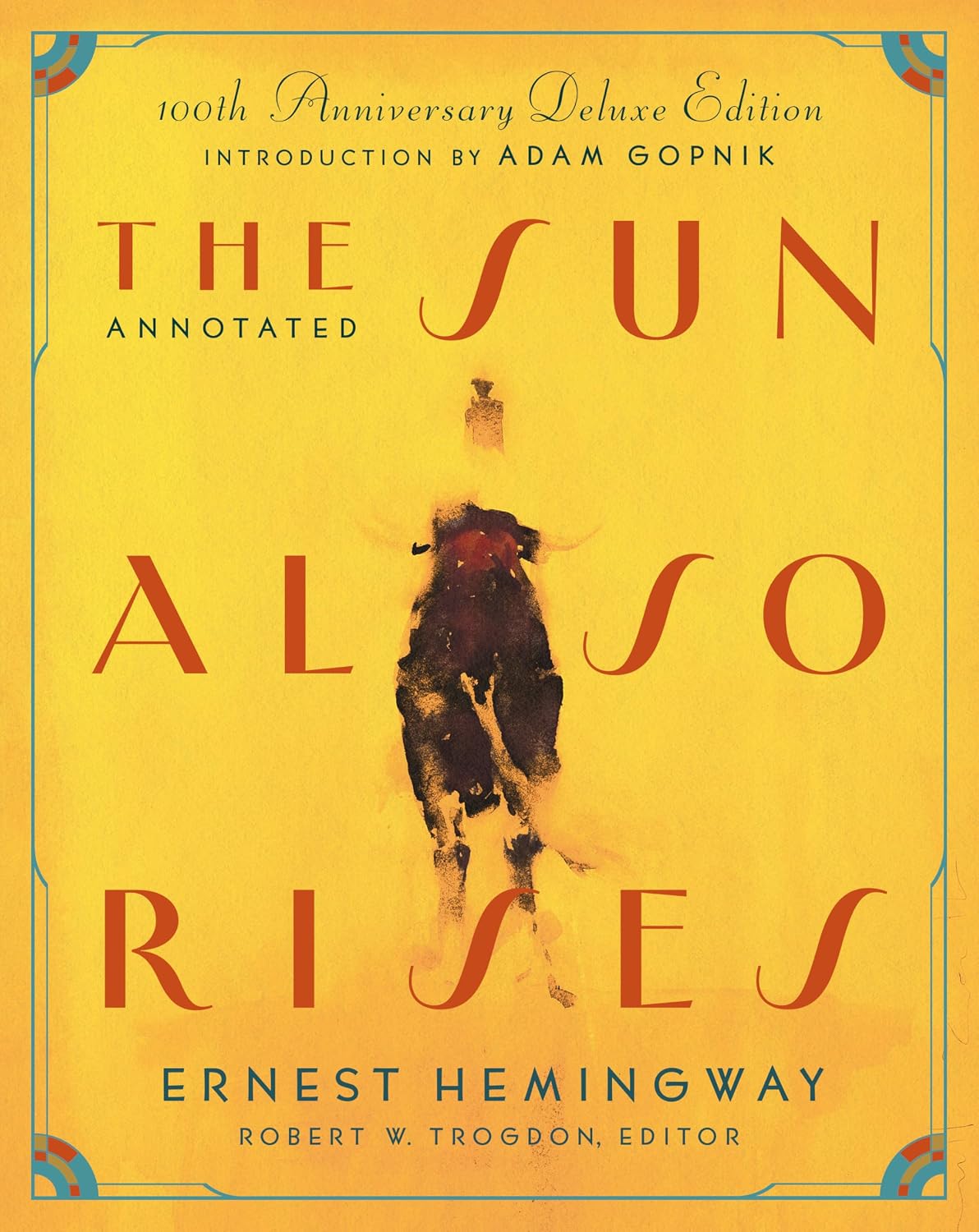
The Annotated The Sun Also Rises. Ed. Robert Trogdon. NY: Library of America, 2026. 346p, $40.
Hemingway created the literary image of Spain for American readers. His descriptions of the Spanish landscape, the explosive festival of San Fermín, the running of the bulls and Pedro Romero’s triumphant corrida reflect the movement from tension to release as the scene shifts from Paris to Pamplona, from moral corruption to regenerative ritual.
This book is the third version of Robert Trogdon’ s edition of The Sun Also Rises, previously published in 2020 and 2022. Like a machine that can’t stop producing the same work, he recalls (with a slight change) Samuel Johnson’s remark: “Sir, a woman’s preaching is like a dog’s walking on his hind legs. It is done well, but you are surprised to find it done at all.”
This edition contains a faithful text of the 1926 novel, 25 pages of relevant letters, a 20-page chronology of Hemingway’s life, 140 excellent photos with captions, including Hemingway fighting a bull in Pamplona, July 1924, and his friend Harold Loeb, with legs raised high in the air, carried on a bull’s head in Pamplona, July 1925. It also has 200 excellent annotations, compiled but not originally written by the textual editor (most of the bullfighting material comes from Death in the Afternoon), with perceptive quotations from major critics: Robert Penn Warren, Mark Schorer, Harry Levin, Leslie Fiedler and Hugh Kenner.
Trogdon’s Preface begins with the mistaken and self-serving claim that tries to justify this edition: Hemingway’s novel “depicts a world and a time that now belongs to the past, no less so than Dante’s Florence or Shakespeare’s London.” But Hemingway’s most artistically perfect book has no medieval theology nor Tudor and Elizabethan history. His American characters are vivid and recognizable, and his novel still seems modern. A few pages later Trogdon contradicts himself by stating of Paris and Pamplona, “Hemingway did much to preserve these places and the people who inhabited them.” In The Dangerous Summer, Hemingway said there were not twenty tourists when he first went to the San Fermín fiesta in Pamplona in 1923. The reckless follies, inspired by his novel and the film version, now attract an incredible million visitors each year.
Adam Gopnik’s Introduction offers a series of useless banalities in mannered prose: “The novel offers some barbed wire and thorns in the perimeter of its effects, ones that must be leapt past and over”; “the surviving bees race across the flowers in search of what nectar they can find before the next bad wind blows”; “how far or close the composer strays from the home key, so to speak, is central to the expressive effect of the music.” This edition is also marred by scores of boring repetitions that are carried from the introduction to the notes, and from one note to another, sometimes turning up on the same page and even in the same paragraph.
I found only one error: fighting bulls weigh 1,100 to 1,540 pounds, not 650 pounds. But quoting Ruth Wisse’s and Dan Goldman’s comparisons of Harold Loeb (the model for Robert Cohn in the novel) to the hopeless and foolish Yiddish schlemiel is absurd. By contrast, Loeb was educated and well-read, a boxing champion at Princeton, a tennis and bridge player, a wealthy expatriate who moved in sophisticated circles, and was the lover of the stunning Brett Ashley. Brett’s real-life model Duff Twysden does not look at all beautiful in her photo.
The two short chapters discarded on the expert advice of Scott Fitzgerald recall Ezra Pound’s severe but valuable editing of T. S. Eliot’s The Waste Land (1922). But they do contain two bright remarks: the promiscuous “Brett had never been very good at being alone” and her lover “Mike Campbell when quite drunk began to be objectionable, and Mike very drunk was embarrassing.” These early chapters also have a classic descriptive passage with simple sentences linked by four “ands,” no commas, present participles, repetitions of “going” and of “work,” which hints at sex work: “we watched the people going by in the dusk on the sidewalk and the great slow horses going by in the dusk on the Boulevard and the people going home from work and the girls starting their evening work and the light coming out of the bistro next door where the chauffeurs from the taxi line were drinking.” In one discarded chapter, Braddocks appears breathing heavily. He is based on Ford Madox Ford, who was gassed in the war, gasps for breath and keeps his mouth open even when photographed.
The intense scholarly interest in literally thousands of books and articles on The Sun Also Rises reveals the surprising complexity and undisputed greatness of the novel. Trogdon’s annotations are thorough and accurate, but considerably more could be added to them.
Epigraph – “The Lost Generation” – All the young men killed in the war were lost forever. The survivors lost their youth and moral standards, and have not been able to find a viable new life.
24- “I paid for the saucers.” – Drinks in cafés were served on saucers, which waiters counted to calculate the bill.
29- The young men with “white hands, wavy hair, white faces, grimacing, gesturing, talking” are satiric portraits of homosexuals.
30- “I just thought perhaps I was going to throw up.” – “Soldier’s Home”: “Krebs felt sick and vaguely nauseated.”
35- “Don’t touch me.” – “Touch me not.” Jesus to Mary Magdalene (John 20:17).
45- “one of us.” – Genesis (3.22) and Stein to Jim in Conrad’s Lord Jim (1900).
48- Grace Hemingway’s condemnation of her son’s novel, which she felt lacked “loyalty, nobility and honor” – foreshadows the bitter passage in A Farewell to Arms: “I was always embarrassed by the words sacred, glorious and sacrifice.”
59- Robert Cohn says, “I’d rather play football again with what I know about handling myself, now.” – Hemingway, letter of 22 April 1950: Scott Fitzgerald said, “If only I could play foot-ball again with everything I know about it now.”
65- “we that live by the sword shall perish by the sword.” – “they that take the sword shall perish with the sword.” Matthew (26.52).
69- In the most subtle and intriguing scene in the novel, Brett speaks and silently acts: “ ‘Darling,’ she said. . . . Then later: ‘Do you feel better, darling?’ ” – Brett has given Jake some rare sexual pleasure.
88- “stud-book.” – Burke’s Peerage.
100- “hotel runners.” – staff sent by hotels to bring in newly arrived passengers.
128- The discussion of irony and pity, of protective defense and essential sympathy, which are the only feelings left after the war, originates with Aristotle’s discussion in Poetics of pity and terror in Greek tragedy.
143- “the Englishman Wilson-Harris” – is based on Hemingway’s close friend Chink Dorman-Smith.
144- Should be “Para ustedes,” not “Por ustedes” (for you).
168- In 1928 a new law decreed that heavy protective pads had to be worn on the picador’s horses, which were no long publicly disemboweled.
168- The perfect bullfighter holds “the purity of line through the maximum of exposure.” –
The perfect soldier could similarly hold “the purity of courage through the maximum of exposure.”
180- Cayetano Ordóñez was the father of Antonio Ordóñez, a great friend of Hemingway, who praised the courage and skill of Antonio in The Dangerous Summer.
228- In 1926, the 26-pesetas barrera en sombra (front row in the shade) ticket for the Pamplona bullfight cost the equivalent of $3.
232- “the heavy leather door” – at the entrance to the church keeps out the wind, cold and heat.
235- “the sand of the bullring was smooth rolled and yellow.” –
258- is echoed in “The beach was smooth and firm, and the sand yellow.”
299- Zelda Fitgerald said the novel was about “bullfighting, bullslinging and bullshitting” (not “bullshit”).
271- The last lines of the novel are brilliantly suggestive:
“Oh, Jake,” Brett said, “we could have had such a damned good time together.”
Ahead was a mounted policeman in khaki directing traffic. He raised his baton. The car slowed pressing Brett against me.
“Yes,” I said. Isn’t it pretty to think so.”
“Could have had” is sadly subjunctive, “damned” is their religious condition. Brett expresses the theme of loss: the effect of Jake’s war wound, their inability to remain together and their permanent pain. “Mounted policeman” and “raised his baton” have sexual suggestions that ironically recall Jake’s incapacity. The last words of James Joyce’s Ulysses (1922) are “yes I will Yes.” Jake says “yes,” it’s pretty foolish “to think so.” He still sees clearly, has no illusions and doesn’t believe they could have had “a damned good time” even if he hadn’t been emasculated. Joyce observed that “Hemingway has reduced the veil between literature and life, which is what every writer strives to do.”
Jeffrey Meyers has published 95 articles and four books on this author: Hemingway: The Critical Heritage (1982), Hemingway: A Biography (1985), Hemingway: Life into Art (2000) and Forty-Three Ways of Looking at Hemingway (2025).



Be First to Comment