
Whistlering in the Dark
by Jeffrey Meyers
James McNeill Whistler (1834-1903) is well known for his expulsion from West Point; for his iconic “Whistler’s Mother,” whose title emphasizes the artist, not the parent; for his pictorial and delicate Nocturnes, which suggests both night scenes and music by Frederic Chopin and Claude Debussy; for his bitter quarrel with John Ruskin; and for his Bohemian dress, tumultuous curly hair, drooping mustache and patent-leather shoes.
Whistler entered the Military Academy in 1851, wasted three humiliating years and was discharged for gross deficiency after failing an examination in chemistry. He wittily observed, “Had silicon been a gas, I would have been a major general.” In his Portrait of the Artist’s Mother (1871), aged 67, the widow wears a black mourning dress, softened by a white lace cap with long ribbons, white cuffs and a white handkerchief clasped on her lap. Seated in profile and facing left, she stares into space and rests her black shoes on a footstool. She has brown (not grey) hair parted in the middle, deep-set eyes, strong nose, puffed cheeks, thin lips and sharp chin. Her harsh unflattering expression is more severe than maternal, more like a strict Nanny than a gentle Mom. The mothers portrayed by the unmarried Mary Cassatt seem more traditionally nourishing and protective.
Ezra Pound perceptively compared Whistler to J.M.W. Turner, and observed that both painters “express beauty in mists, shadows, a hundred places where you never dreamed of seeing it before.” The art historian Robert Dorment wrote that in Whistler’s Nocturne in Black and Gold: The Falling Rocket, set on the Thames, “the explosion of orange light in the centre is the climax of the event, in which rockets, flares and illuminations have been set off at once. The whole picture imitates the path of the rocket from launch to explosion and dying fall.” In 1877 John Ruskin, who enjoyed godlike status as an art critic, attacked Whistler’s most brilliant Nocturne by declaring, “I have never expected to hear a coxcomb ask two hundred guineas for flinging a pot of paint in the public’s face. The ill-educated conceit of the artist nearly approached the aspect of willful imposture.” The artist sued for libel and was awarded an insulting farthing with no costs.
Whistler was the model for the talented, glamorous and famous sculptor Gloriani in Henry James’ novel The Ambassadors (1903). But the sharp-witted Edgar Degas saw through his fake pose: “Whistler loves to wrap mystery around him as a cloak—and then go off in it and be photographed.” Whistler was frightened of Degas, who perceptively told him that he didn’t need to create a false persona to promote his art: “You behave as though you had no talent.” When Whistler, monocled, top-hatted, frock-coated and carrying a tall cane triumphantly entered a restaurant where Degas was dining, the painter deflated him by remarking, “Whistler, you have forgotten your muff.”
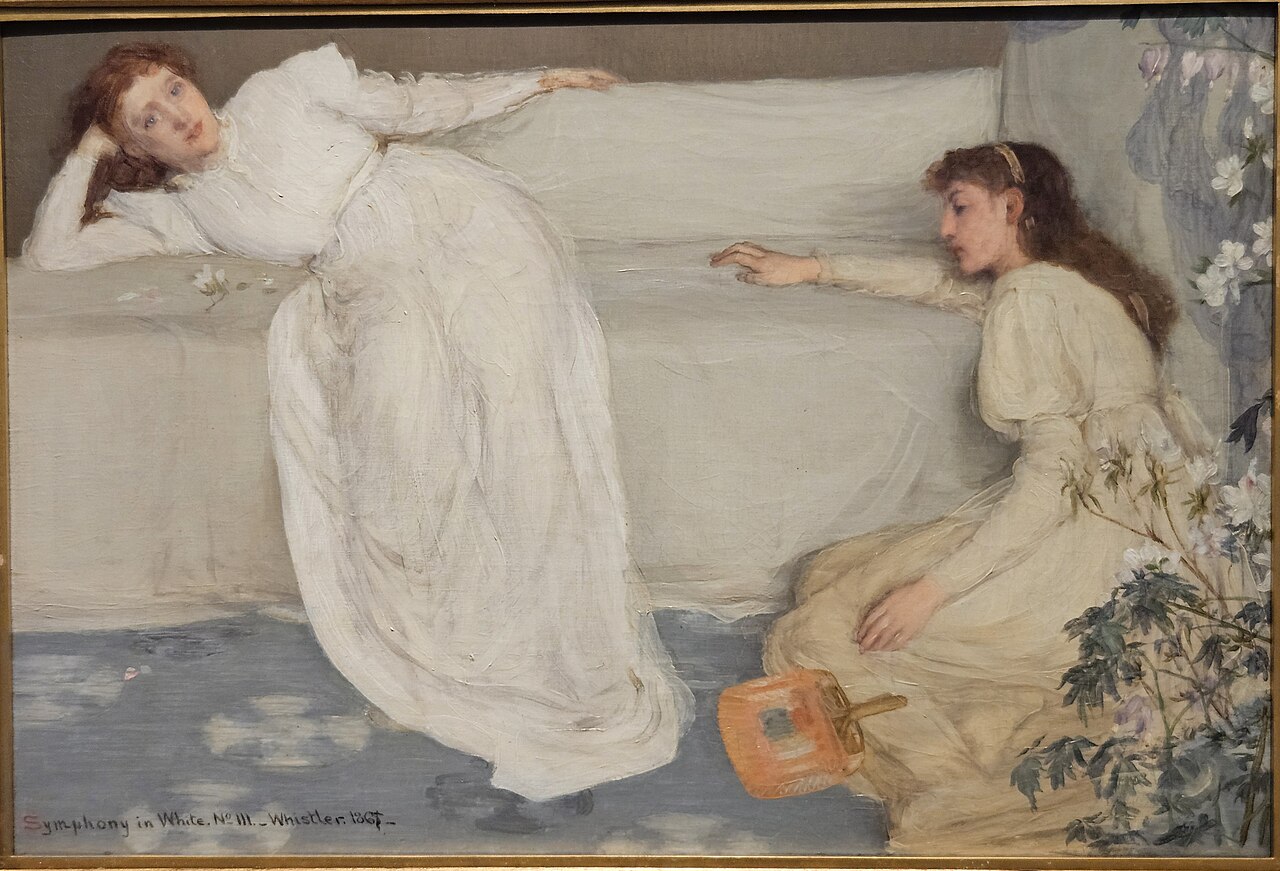
Daniel Sutherland’s Whistler’s Legacy (Penn State University Press, 2026, 263p, $43) does not discuss Whistler’s great portraits. In Symphony in White No.1: The White Girl (1862) Jo Hifffernan, his mistress and muse during the 1860s, stands in front of a tall white curtain. Her long white dress has puffed shoulders, ruffled sleeves and high-waisted belt. The hem rests on a blue-patterned carpet covered in a wolf-skin rug, and the animal’s ferocious expression contrasts with her sweet face. She holds a Pre-Raphaelite white lily as a mass of coppery-red hair cascades over her shoulders. She has wide staring eyes, a full mouth and arms dangling at her side—the perfect image of Wilkie Collins’ heroine in his novel Woman in White (1861).
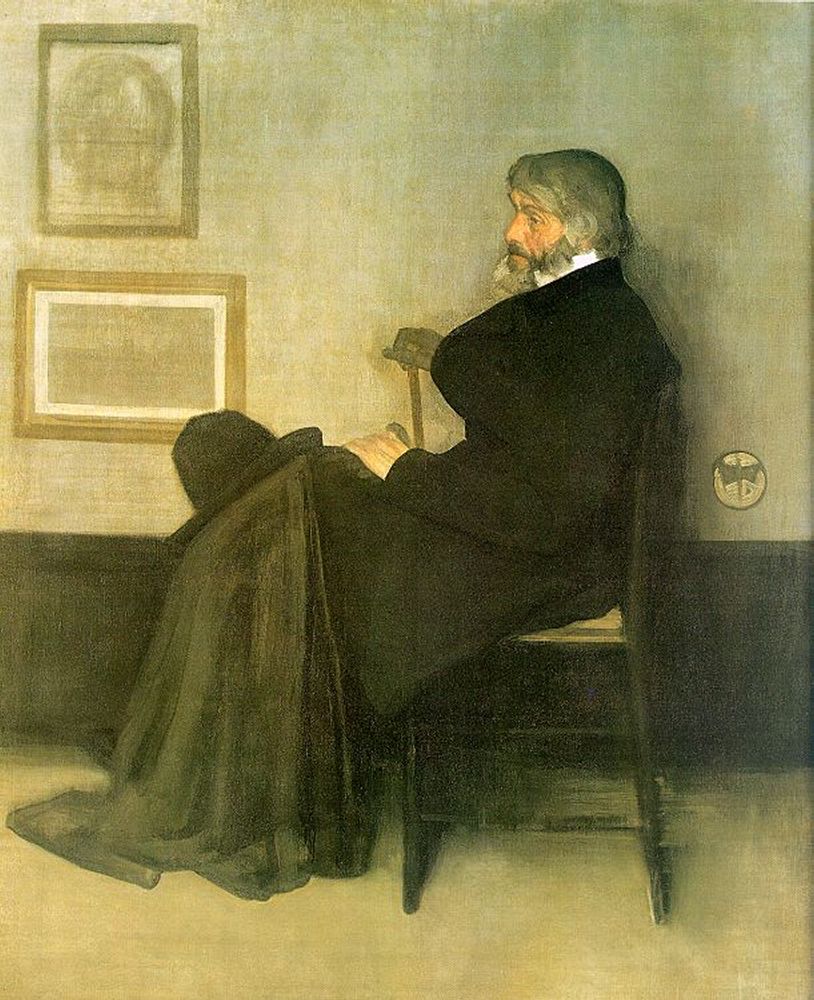
Portrait of Thomas Carlyle (1873), aged 78, portrays the Victorian sage seated in profile and facing left, against a greyish-green background. Dressed in black with a flash of white collar, he rests his left hand on his lap and dark hat on his knee. His shaggy grey hair sweeps across his forehead and thick beard falls to his chest. He has a strong nose, lined face, contemplative and rather sad look, as if he were still mourning his late wife.
Daniel Sutherland published a biography of Whistler in 2014. His learned but long-winded Whistler’s Legacy gathers the remains of his research, and “explores how Whistler’s life and art have been judged since his passing in 1903.” The book has no dust wrapper and the cover exhibits a muddy portrait of Whistler by Charles Corbin. Sutherland breaks a butterfly upon a wheel by devoting 22 pages to Elizabeth and Joseph Pennell’s Life of Whistler (1908). (Mohammed Ali transformed Whistler’s “stinging butterfly” signature into “Float like a butterfly, sting like a bee.”). The painter Walter Sickert had condemned the Pennells’ book as “full of false assumptions, inaccurate critiques and questionable stories,” and they even mistook the date of Whistler’s funeral that they attended. Another 29-page chapter features dud books by mostly forgotten scribblers, and even the significant authors—George Moore, Arthur Symons, Frank Harris and Theodore Duret, a friend of Manet who had his portrait painted by Whistler and wrote a book about him—are not particularly insightful. The next 40 pages fail to note one book or article that’s worth reading, and the novels and plays in which Whistler appears as a fictional character range from mediocre to abysmal. It’s difficult to get interested in this material. As Edmund Wilson said of thrillers, “Who cares who killed Roger Ackroyd?”
Sutherland doesn’t mention Wyndham Lewis, though the two artists had flamboyant personalities, wore broad black hats and eccentric dress, and the ironic title of Whistler’s The Gentle Art of Making Enemies (1890) surely influenced Lewis’ The Art of Being Ruled (1926). Sutherland quotes several writers, devoted to or indebted to Whistler, who unconvincingly tried to whitewash his character. They describe the saintly figure as kind, generous and sensitive; “sweet at the core, and free from personal jealousies”; “courteous, kindly and affectionate, with a loveable side to his nature.”
But these cheerleaders are overwhelmingly contradicted by the harsh and often wounded recollections that emphasize his similarities to Lewis. In mano-a-mano contests Whistler was also contentious and combative, erratic and irrational, aggressive and provocative; magnetic, strange and ferocious; “spiteful, venomous and full of hatred.” His “intemperate language and bizarre conduct” erupted in “the most unfortunate and uncontrolled outbursts of scorn, sarcasm and vindictive wit.” The word “enemy” appears in Whistler’s correspondence, and he boldly declared, “I most love my enemies. They keep me always busy, always up to the mark, either fighting them or proving them to be idiots.” Lewis, a self-styled Enemy, published three issues of a journal called The Enemy from 1927 to 1929.
Most significantly, both Whistler and Lewis had two illegitimate children and placed them with foster parents. Both mistreated their mistresses. Whistler deposited his woman in a London hotel during her second pregnancy so he could concentrate on his battle against John Ruskin. When Lewis’ mistress returned from the hospital with her newborn baby, he kept her waiting on his front steps while he finished having sex with Nancy Cunard. The aggressive personalities of both artists helped create their legends. Their anger came from a sense of betrayal and Lewis, like Whistler, “allowed his argumentative, pugnacious, cantankerous and litigious side to shape his legacy.”
Jeffrey Meyers has published The Enemy: A Biography of Wyndham Lewis (1980) and Wyndham Lewis: A Revaluation (1980).






Be First to Comment