
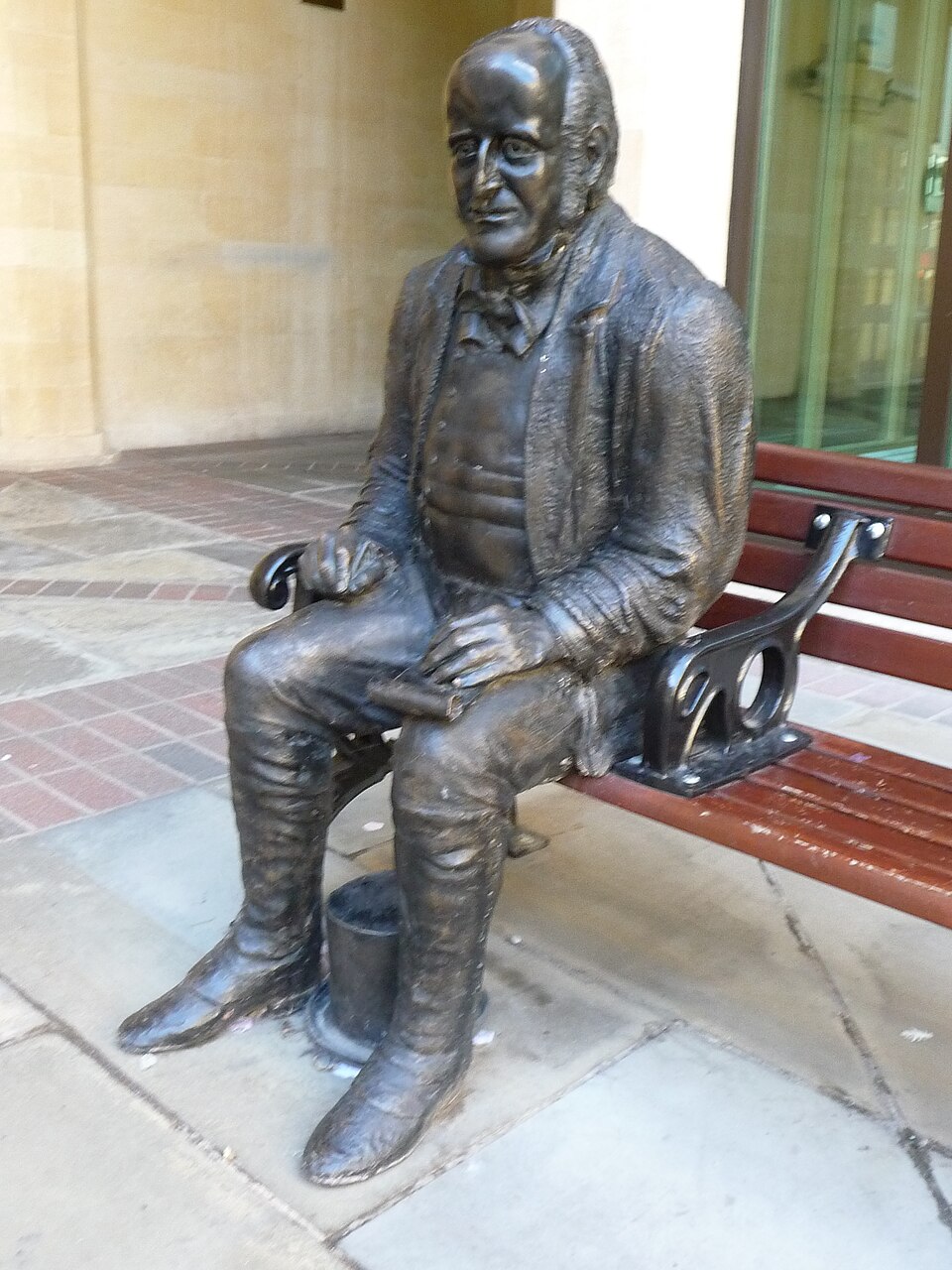
John Clare: Faithful Are the Wounds
Jeffrey Meyers
In an appreciative essay of 1992, Seamus Heaney notes the principal events in the life of John Clare (1793-1864). The Enclosure Act of Parliament in 1809 gave previously common land to private owners and adversely affected his native village, Helpston, Northamptonshire. To Clare it seemed like the loss of Eden. He wrote:
Now all laid waste by desolations hand
Whose cursed weapons levels half the land.
Inclosure came & trampled on the grave
Of labours rights & left the poor a slave.
Heaney also mentions Clare’s traumatic move from Helpston at the age of 39; his frequent depressions, delusions and hallucinations; his desperate love for his childhood sweetheart and belief that he was married to her as well as to his wife; his entry into a mental hospital in Epping Forest, Essex, in 1837; and his heartbreaking journey of escape from there in 1841. “He ended up in Northamptonshire Asylum for the last twenty years of his life, having spent his late thirties and forties in mental confusion, economic distress and poetic neglect.” Like Clare, other gifted writers and artists have been placed in insane asylums: the poet Christopher Smart, the painter Richard Dadd, Zelda Fitzgerald, Robert Lowell, Anne Sexton and Sylvia Plath.
The faint print and shiny paper in Sarah Houghton-Walker’s John Clare (Reaktion, 2026, 190p, £13pb) make it hard to read, and her competent but rather dull book has no index nor list of Clare’s poems. Organizing the book by chapters based on the places where Clare lived is not effective, since most of the rural villages are quite similar and he often returned to his native Helpston.
A contemporary described the 5-foot, 2-inch Clare as “low in stature, with long visage, light hair and coarse features. Ungainly and awkward, he is a fiddler, loves ale, likes the girls, somewhat idle and hates work,” which distracts him from writing poetry. In his idealized portrait by William Hilton (1821) he has high cheekbones and a strong chin, and looks remarkably like the German poet Friedrich Schiller. Sexually promiscuous with both prostitutes and girlfriends, Clare caught venereal disease, and was obliged to marry his lover when she became pregnant. He had seven children and was always on the brink of destitution and hunger. His craving for strong beer made the solitude of the loner and misfit apparently less irksome but actually much worse.
Despite lifelong poverty, Clare’s politics were conservative: “With the old dish that was served to my forefathers I am content. But I believe the reading of a small pamphlet on the Murder of the french King many years ago, with other inhuman butcheries, cured me very early from thinking favourably of radicalism.”
After the success of his first book of poems in 1820, Clare took the coach to London. He was feted, met the leading drug addicts Coleridge and De Quincey, as well as Charles Lamb and Sir Joshua Reynolds. He saw the funeral procession of Lord Byron, whose body had been preserved in spirits and sent from Greece. He wrote a sonnet on Byron, weak imitations of Byron’s Childe Harold and Don Juan, and when mad imagined that he himself was actually Byron.
Clare was too delicate for the agricultural life and too rustic for the literati. Like a modern rock star, his life was undermined and finally destroyed when he lost his old identity and failed to find a new one. He frequently lamented, “My strength was feeble and like my mind strange and unfit with the world. I swooned into chilliness and dithering, and when I turned senseless and fell, sparks as if fire flashed from my eyes when I dropt. I am very nervous that is to say very crazey–& in consequence very uneasy.” He was constantly plagued by “no sleep, a general debility, a stupid & stunning apathy or lingering madness & death.”
In 1837 his symptoms became more severe and he was committed to High Beech Asylum in Epping Forest. His condition when confined was relatively mild, and he was not violent, idiotic, mischievous, dirty nor epileptic. In July 1841 he casually walked out of the Asylum and headed toward home, but was afraid of being spotted and accused of trespass. He traveled 25 miles on the Great North Road the first day, ate grass, became exhausted, slept rough and had uneasy dreams. A human compass, he lay down with his head pointing north so he would not lose his way in the morning.
Recertified insane, he entered the Northampton Lunatic Asylum in December 1841 and remained there until his death in 1864. In the age of barbaric treatment, his keepers were humane and enlightened. He was allowed to walk about town and was encouraged to write poetry—though he could scarcely be stopped.
Clare wrote a poem to “Lucy of Northampton,” and James Joyce’s daughter Lucia died in the same Northampton Asylum in 1982. But the striking parallel with Clare goes far beyond Joyce’s surname and Lucia’s link with the madhouse. The young Clare was in love with a girl called Mary Joyce and later thought he’d formed a bigamous marriage with her. Clare emphasized their purity and sweetness. When he courted her and they took country strolls, “we walked together as school companions in leisure hours but our talk was of play and our actions the wanton innocence of children.” But their different social classes forced them to part: “when she grew up to womanhood she felt her station above mine, for her parents were farmers.” Mary Joyce remained fixed in Clare’s imagination until the end of his life.
Clare’s narrative bears a striking resemblance to Gretta Conroy’s life in Joyce’s great story “The Dead.” Gretta, once in love with Michael Furey, confesses that she was “great with him at that time. We used to go out walking the way they do in the country.” Furey knew that class differences would never allow him to marry Gretta and feared that when she left for Dublin he might never see her again. Gretta also formed a symbolic bigamy with her real husband, Gabriel, and with the powerful memory of the lost love of her youth, Michael Furey.
Clare belonged to an eighteenth-century tradition of untutored peasant and artisan poets—Stephen Duck, the poetical thresher; Henry Jones, the poetical bricklayer; James Woodhouse, the poetical shoemaker; Ann Yearsley (“Lactilla”), the poetical milk-woman—that culminated in Robert Burns, the first truly talented peasant-poet. Like Burns, Clare was ruined by drink and sexual temptations, as well as by mental illness.
At one with nature if not with himself, Clare recalled that when working in the fields and driven by the creative impulse, “I used to drop down behind a hedge bush or dyke and write down my things upon the crown of my hat.” His lively dialect words, not found in Samuel Johnson’s Dictionary, were explained in the Glossary of his first book: getty (party), mozzly (mingled), drowking (drooping), pursy (panting), shanny (foolish) and glumpy (sullen).
Clare’s “The Holiday Walk” describes how a military invasion of wasps and their comrades ruined an outing with his children. His closely observed poem opens dramatically without punctuation and ends with a touch of humor:
Stop theres a whasp nest what a bustle & hum
Like legions of armies where danger is come
There they rush one by one in their jackets of yellow
No one offers fight but he’s backed by his fellow. . . .
& if you sit on them as small as they are
They’ll sting you & teaze you so prythee beware.
Oral sex suddenly appears with comical rhymes in his parody of Byron’s Don Juan:
Childern are fond of sucking sugar candy
& maids of sausages – larger the better
Shopmen are fond of good sigars & brandy
& I of blunt – & if you change the letter
To C or K it would be quite as handy.
Clare’s three most tender, savage, cruel and agonizing poems all concern sympathetic victims: mouse, badger—and himself. “Mouse’s Nest”—a parable of an animal’s vulnerability and mutability, the approach of death and terror of dying—recalls the mood, but not the sentimental moralizing, of Robert Burns’ “To a Mouse,” about a beastie he’s saved from the plowman’s blade. Clare’s poem also foreshadows the fearful creatures in Richard Eberhart’s “The Groundhog,” Richard Wilbur’s “The Death of a Toad” and Thedore Roethke’s “The Meadow Mouse.”
In his vibrant sonnet “Mouse’s Nest,” Clare frightens a mouse who’s nursing her young in a field. He doesn’t at first recognize the strange maternal creature, and when he leaves her in peace, the mouselings stop squawking and the mother scurries to safety in her hideout. Tranquility is restored and reflected in the placid waters of the closing lines, when even the cesspools brighten up:
When out an old mouse bolted in the wheats
With all her young ones hanging at her teats;
She looked so odd and so grotesque to me,
I ran and wondered what the thing could be,
And pushed the knapweed bunches where I stood;
Then the mouse hurried from the craking brood.
The young ones squeaked, and when I went away
She found her nest again among the hay.
The water o’er the pebbles scarce could run
And broad old cesspools glittered in the sun.
In “Badger,” vicious men, reverting to primordial bestiality, use dogs to trap, bait and torment the heroic badger, who resists with courage, strength and cunning until he’s finally beaten and bitten to death. The couplets lock together with a rough, pulsing rhythm that mark the animal’s advances and retreats, and describe the fate—after a brief triumphant grimace—of the trapped, doomed, pathetic creature:
He tries to reach the woods, an awkward race,
But sticks and cudgels quickly stop the chase.
He turns agen and drives the noisy crowd
And beats the dogs in noises loud.
He drives away and beats them every one,
And then they loose them all and set them on.
He falls as dead and kicked by boys and men,
Then starts and grins and drives the crowd again;
Till kicked and torn and beaten out he lies
And leaves his hold and cackles, groans, and dies.
Like Rimbaud’s declaration “I Is Another,” “I Am” describes Clare’s disastrous loss of identity and selfhood. He compares his isolation and anguish to a shipwrecked existence, a vast nothingness of noise, scorn and inexorable madness:
I am: yet what I am none cares or knows,
My friends forsake me like a memory lost,
I am the self-consumer of my woes—
They rise and vanish in oblivious host,
Like shadows in love’s frenzied stifled throes—
And yet I am, and live—like vapours tossed.
The poem concludes with the hopeful but impossible wish to return to the sweet sleep of childhood: “Untroubling, and untroubled where I lie, / The grass below—above the vaulted sky.”
William Cowper’s “The Castaway” (1799) uses the shipwrecked image more powerfully to express his own solitude and agonizing insanity:
No voice divine the storm allay’d,
No light propitious shone;
When, snatch’d from all effectual aid,
We perish’d, each alone:
But I beneath a rougher sea,
And whelm’d in deeper gulfs than he.
Leslie Stephen’s judgment on Clare is sound and convincing: “Though he shews fine natural taste, and has many exquisite descriptive touches, his poetry does not rise to a really high level, though extraordinary under the circumstances.”
Clare’s 20th-century avatars, minute observers of nature, include Edward Thomas, Ted Hughes and Ronald Blythe. The finest tribute to Clare comes from another lyrical nature poet and manic-depressive, Theodore Roethke, whose work was also inspired by mental illness. Addressing himself in “Heard in a Violent Ward,” Roethke places himself in the tradition of mad poets:
In heaven, too,
You’d be institutionalized.
But that’s all right,–
If they let you eat and swear
With the likes of Blake,
And Christopher Smart,
And that sweet man, John Clare.



Be First to Comment