
Complexifying Performativity
by Jeffrey Meyers
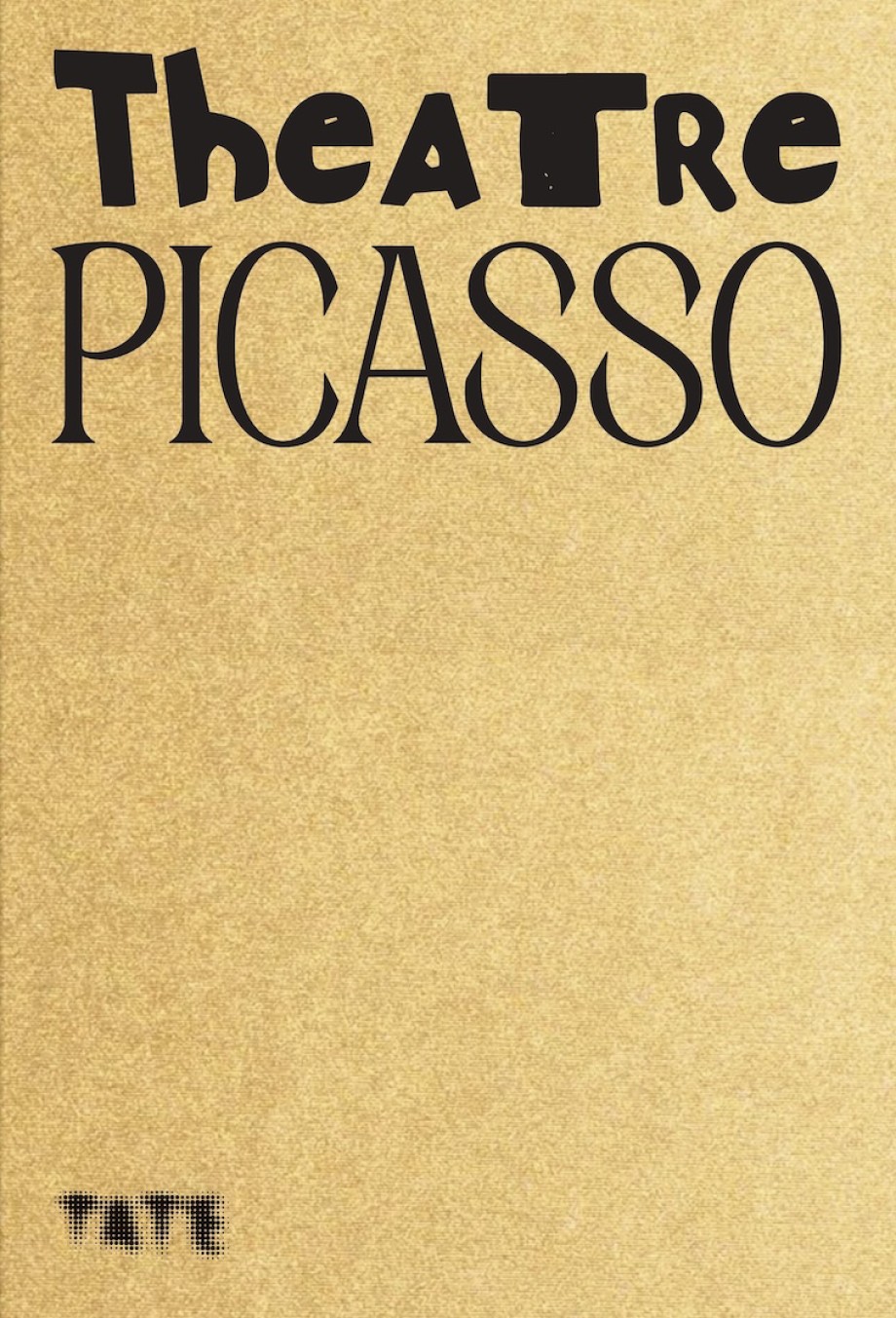
Theatre Picasso. Ed. Rosalie Doubal and Natalia Sidlina. London: Tate Modern, 2025. 128p, £25.
The editors say that Picasso’s Three Dancers (1925) “presents a stage shaped by the confines of a room where three figures shift and transform against the backdrop of an open French window. . . . On the right side, silhouetted against the backlit window, is the figure of Ramon Pichot, Picasso’s friend, whose death the artist learned of while painting this work.”
The exhibition to mark the centenary of this painting does not, as the misleading title suggests, “explore the relationship between Picasso and theatre.” Instead, the catalogue emphasizes “performance within Picasso’s work” and “what an artwork does, rather than what it ‘says.’ ” Unfortunately, “the drama of that plastic act” does not “complexify the myth of Picasso.”
The contributors don’t mention Stravinsky, Diaghilev or Nijinsky in connection with Picasso’s designs of the theatrical sets and costumes for the Ballets Russes in 1917, nor his transformation from a modest to a luxurious life after his unfortunate marriage to the Russian ballerina Olga Khokhlova.
This book is replete with obvious and banal statements: Picasso’s portrayal of the artist in his studio “is deeply entwined with the dynamic between painter and model,” and
“he fashioned his own public persona, ultimately becoming a globally recognized icon.” At the fag-end of Picasso studies the contributors try to do something original but their dance fails to illuminate his work. Stealing into the museum on Picasso’s fame, they offer disparate subjects yoked by violence together that have no meaningful connection to the artist.
The self-aggrandizing chapter, “Notes on Theatre Picasso,” is torture to read.
The argument is not advanced by quoting an obfuscating critic who states, “The ‘queer’ potential of performativity is evidently related to the tenuousness of its ontological ground,” and by stating that Picasso “disfigured naturalistic and normative conceptions of what has come to be ordered as the production of subjectivity.” Instead of discussing the meaning of his art they tediously roll out the litany of self-righteous clichés about hegemony, emancipation, race, gender and class, to proclaim their PC credentials.
One even more boring essay constantly forces the connection between Picasso and flamenco. There’s no evidence that the artist’s early girlfriends were flamenco dancers or that flamenco has anything to do with Jewish traditions. The author does not advance his thesis by quoting a folklorist who argued “phenomena that are socially peripheral can become symbolically central.”
A third weak chapter admits that the flamenco performance accompanying Theatre Picasso is not directly related to his work, but nevertheless maintains that it “can offer us valuable tools to further expand our explorations around Picasso and the idea of performativity.” I’ve seen flamenco dancing in the gypsy caves of Grenada, in cafés, theaters and in films. The endless clapping hands, stamping heels and swirling costumes soon become wearisome.
Patricia Leighten quotes herself 13 times on only 7 pages (if you don’t have a dog you must do your own barking). On the same page she rolls out the old clichés about “Africans suffering under the oppressive rule of European colonisers” and forces the comparison by claiming that Picasso’s art “exposed parallels to the scandal over French colonial exploitation and abuse.” Does Leighten really believe that life in the Sudan, which has suffered continuous civil war and genocide that has killed millions of people since independence in 1956, is better now than under the law and order of British rule? I doubt if the Spanish Picasso got worked up about French colonialism. Leighten’s essay is more persuasive by stressing his “antimilitarism and lifelong commitment to justice.”
Other contributors don’t say that Nathaniel Mackey’s tedious and irrelevant poem on death and loss, which takes up 4 pages, was modeled on García Lorca’s elegy on the death of a matador, “Lament for Ignacio Sánchez Mejías.”
The contributors don’t bother to analyze the best paintings in their catalogue.
The gaunt, almost starved figure in Girl in a Chemise (1905) stands three-quarter length and in profile before a mournful blue background. She has high-piled dark hair, long ears, sharp nose, bitter lips, jutting chin and a surprisingly prominent pointed left breast. Though her expression is forbidding, she’s strangely attractive.
Portrait of Gertrude Stein (1906) is modeled on Ingres’ monumental Portrait of Monsieur Bertin (1832). The massive seated woman, draped in a thick brown robe, rests her open-fingered-hands on heavy thighs. She has thick dark hair, high tan forehead, masklike face, asymmetrical eyes, strong nose and firm lips. Her white scarf and red brooch provide the only color. Her statuesque figure combines the image of a sumo wrestler and a dominatrix.
There’s absolutely nothing in the painting Les Demoiselles d’Avignon (1907) to justify the widely accepted claim, repeated in this catalogue, that the five women are prostitutes. In fact, the tight group of naked bodies dancing with raised arms look more like the three Graces in Botticelli’s Primavera than the denizens of a whorehouse.
The sensual and delightful Nude Woman in a Red Armchair (1932) portrays Picasso’s lover Marie-Thérèse Walter. It shows two sides of her character and his ambivalent attitude to her. The moon-faced beauty has contrasting features: both blond and green hair, white and blue face, looking straight ahead with a profile tilting to the left. Her arms are raised with curved hands supporting her chin. She wears a necklace of round green emeralds and sits on a wooden armchair with bright red padding nailed to the back. Her breasts are full, her hairless vulva daintily cleft and seductive.
Weeping Woman (1937) turns from love to the pain of love. She wears a floppy red hat decorated with a blue flower, thick blue hair flowing down to her shoulder, protruding eyes with spiky eyelashes, large dripping tears, square feral teeth and green simian fingers, which portray Picasso’s agonized relations with Dora Maar.
Ubu in Chains (1937) portrays the eponymous character in Alfred Jarry’s surrealist play Ubu Roi (1896). The hideously deformed face looks two ways. One eye is straight ahead, the other eye and pig-snout nose are in profile. The thick-lipped open mouth is twisted around and the head looks indented from a war wound.
This catalogue reproduces Picasso’s book illustrations for Aimé Césaire’s Lost Boy (1949), as well as the head of a Bullfighter (1949) and picador in Bullfight Scene (1960). The lady’s colorful costume in Portrait of a Woman after Cranach the Younger (1958) resembles the elaborate attire of a Spanish dama at a corrida, hinting at a matador’s traje de luces.
I own a handsome copy of Picasso. Toros y Toreros, which could have been included in the book and bullfight chapter of this exhibition. It has an essay by the great torero Luis Miguel Dominguín (whom I interviewed) and a study by the French art historian Georges Boudaille, both translated by Edouard Roditi. This lavishly illustrated folio-size volume, with 32 pages of text and 162 pages of illustrations, was published in Paris by Editions Cercle d’Art in 1961. The rear endpaper reproduces a yellowing bullfight poster from Málaga on June 12, 1873. Picasso, who frequently saw Dominguín fight in French bullrings, painted three sides of the clothbound book and case. He made rapid, vivid sketches—with pencil, colored crayons, red and black ink—of all aspects of the corrida: the procession, the banderillero, the picador, the matador’s cape work and the kill. He also surprisingly included a sketch of Christ on the Cross saving a picador from death.
Jeffrey Meyers, FRSL, has published Painting and the Novel, Impressionist Quartet, biographies of Wyndham Lewis and Modigliani, and a book on the Canadian realist painter Alex Colville.


Be First to Comment