
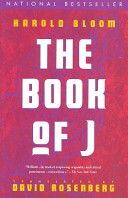
The Book Of J
By Harold Bloom
Translated by David Rosenberg (1990)
Review by Dan Geddes
11 October 1999
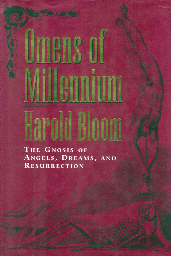
See also reviews of Bloom’s The Anxiety of Influence, Omens of Millennium, and The Western Canon.
Although ostensibly a book of literary criticism, Bloom’s Book Of J, does more than stake out a claim for the J writer as one of the giants in Western literary history, he also uses his interpretation of the Book Of J to attack what he refers to as the “normative tradition” of Christianity and Judaism: the Yahweh depicted in the Book of J does not provide the foundation for the Judaeo-Christian ethic, nor for many other ideals that we associate with Christianity.
German high criticism of the Bible, beginning in the early 19th century, discovered that the Pentateuch (first five books of the Bible, commonly ascribed to Moses, except by scholars) was based primarily on earlier works, and had undergone centuries of revision[1]. The earliest source book of the Five Books, the work of the so-called “Yahwist” or “Jahwist” (J writer) predates the works of the P or Priestly writer, the E or Elohist writer, and the R writer, the Redactor, who is most responsible for the shape of the five books we have today, as well as for the Hebrew Bible. According to Bloom, the “normative” interpretation of the Pentateuch is due to subsequent revisions, and is wholly absent in the earliest writer, the J writer.
Instead what we get from the Book of J (newly translated from the Hebrew by David Rosenberg, his translation of the text forming the middle portion of this book) is a writer of sublime irony; a writer with close affinities to Shakespeare or Kafka. J was not a religious writer. Her depiction of Yahweh should be considered blasphemous by believers in the normative tradition. Her Yahweh suggests reality itself, or the ironic place of man in a universe that places limitations on his actions, rather than any ethereal being shorn of human-all-too-human characteristics.
According to Bloom’s interpretation, Yahweh is always somewhat impish and self-contradictory. His formation of man from clay suggests a “child making mud pies” and J’s depiction of the creation of man differs from other ancient near Eastern creation stories in that Yahweh does not use “the potter’s wheel,” found in Egyptian myths among others. Moreover, the created man is monist, an integrated living being, rather than a being of spirit, soul, and body. (In Hebrew, “soul” conveys the sense of the whole living person, kind of like our phrase “not a soul”.) Bloom finds it somewhat ironic that Adam is allowed to name all the animals, while he futilely seeks a mate among them. This is but the first instance of Yahweh’s effect on Man, which is primarily to remind him of his incommensurateness.
That the J writer spends about six times more space covering the creation of woman than she did the creation of man is but one indication that the J writer was a woman (more on this later).
In Rosenberg’s translation, reinforced by Bloom’s interpretation, the Garden of Eden story lacks an Original Sin sort of theme. Yahweh himself seems extraordinarily self-contradictory and obstructionist by creating a creature that he wants to obey him, yet forbids him to eat from the Tree of Knowledge of Good Or Evil, or apparently the Tree Of Life (the Tree Of Life being a familiar symbol(?) from other ancient Near Eastern myths). That “Hava” and Adam do so is seen more as an instance of childlike curiosity than anything resembling original sin. Neither the snake nor Hava come off very badly in J’s Eden, and it is Yahweh himself who looks unseemly, by forbidding them to eat the fruit of the tree in the first place, and then later meting out a punishment far in excess of the crime.
But again, according to Bloom the point of the story is not about good or evil (which never really concern Yahweh or the principle players of the Book of J). For Bloom, these normative concerns were written in later (as was the majestic creation story of Genesis 1, and the phrase of God creating man in “our own image”). It is about childlike disobedience of the father, and punishment incommensurate to the crime. It is Kafkaesque, in that Yahweh, as reality, doles out a fate that is undeserving and inexplicable.
J’s Yahweh is a far cry from the gaseous vapor God handed down by the normative tradition. Yahweh is very anthropomorphic compared to the God of the rest of the Bible (or man is theomorphic, see below). He is human-all-too-human, and frequently appears on the earth in person: walking in the garden, asking if Adam disobeyed him (when, if omniscient he should know), giving an on-the-ground inspection before he confuses the speech at Babel (again, an indicator of Yahweh wanting man to be like him, but thwarting him when he tries), closing up Noah’s ark with his own hands, allowing Sarah’s insolence when she doubts she will bear a child, haggling with Abram over the number of good people it would require for Yahweh to not destroy Sodom; allowing his blessing to be “stolen” a few times by the cunning Jacob, who wrestles with either Yahweh himself or one of the Elohim (“angels”) to re-earn it; attempting to murder Moses, his own recently chosen prophet; leading the Israelites in the wilderness for little apparent reason; and not allowing his reluctant chosen prophet to even see the Promised Land (another instance of Yahweh’s thwartations).
Yahweh, for Bloom, is a very complex character, and there is no allegorical signified for which he stands. Yahweh, is a life-force, Yahweh is reality itself, especially in its relation to man, Yahweh represents limitations (in regard to man) and the breaking of limitations.
Hence his Blessing, which the patriarchs covet and wrangle for, is very much a Mixed Blessing. Jacob spends much of life trying to secure it, from clutching Esau’s heel at birth, to trading Esau a pot of porridge for it, to wrestling one of the Elohim (or Yahweh himself) for it in a nighttime wrestling match. And once he gets it, he still suffers. The Blessing gets passed down to Judah, the fourth son, because of the inadequacy of the elder brothers; but it seems to be Joseph, who really has the blessing, whose character it would be most accurate to say of, that Yahweh was with him. The power of Yahweh is charisma, vitality, and even good fortune, rather than righteousness, a quality that never concerns J or her Yahweh.
A prohibitive problem for interpreting the book of J, according to Bloom, is peeling off the varnish of centuries of misreadings, because of the book’s redaction and incorporation into a very normative text, the Hebrew Bible. Because we always tend to read Genesis and Exodus with the advent of Christ in mind, and the attached normative tradition of morality, we find it difficult to realize just how impish and capricious J’s Yahweh was. Yet the power of J’s writing was such that so much of her work survives the numerous revisions and deletions of P, E, and the dreaded Redactor.
If undermining the foundations of the entire Western spiritual tradition wasn’t enough for Bloom, he also asserts the somewhat startling thesis that the J writer was a woman. This part of his argument is not entirely convincing, despite his always referring to J as ‘she’. It’s not that it is so inconceivable; it is just there is no extra-textual evidence that identifies J’s gender, age, era, or anything else about this writer. Bloom relies on textual indications, such as the fact that the women in J–Sarah, Rebecca, Rachel, and especially Tamar–are given kinder depictions than many of the men.
Yet Bloom is not tentative at all about offering guesses. According to Bloom, the Book of J was probably written in the generation after Solomon (c. 9th Century B.C.E.), as Jeroboam and Rehoboam were dividing the grand Israelite empire of David and Solomon. J was probably a woman of the Solomonic court, well versed in literature, and, along with the writer of 2 Samuel, one of the chief representatives of what the German scholar Rad has called the “Solomonic Enlightenment.”
In fact, David is perhaps the formative influence on the J writer. David represented human grandeur, a poet and a warrior, representing the highpoint of Israel’s history. David was charismatic and enthusiastic; full of elan and moxie. According to Bloom, the entire point of the Book of J is to sketch a background of David’s ancestors, for Yahweh’s love of David is the most important thing about him (Yahweh). That Yahweh showered favor on David is most clear, and to a Solomonic litterateur like J, that is far more important than the Exodus.
But despite all the theological ramifications of the Book of J (and Bloom seems to cheerfully and nonchalantly treat the “normative tradition” as completely misguided), The Book Of J is primarily a book of literary criticism. The book moves from an explanation of what the Book Of J is in terms of the textual history of the Bible, to an admonishment that the reader will not see J as a great ironic writer unless he can rid himself of “normative” presuppositions; then we are given Rosenberg’s new translation of The Book Of J (a little over one hundred pages of text); then Bloom applies his formidable critical powers to the text, and finally we are given a sense of J’s place in literary history.
Based on Rosenberg’s translation, Yahweh bears little resemblance to the God we usually imagine. And this is not just in J. The God of Genesis and Exodus does strike us as “mythological,” especially compared to the unseen God of the New Testament. God walks the earth, talks in person to Adam, Noah, Abram, Moses, etc.. Both the serpent and Balaam’s ass can talk. Genesis does seem like the “sophisticated children’s literature” Bloom calls it.
Bloom’s interpretation is that the Book of J is not primarily “religious” writing, and that the Yahweh depicted in it says more about humanity and its limitations than the nature of the divine, whatever that is. Also, Yahweh doesn’t seem to have much in the way of “normative” concerns, especially considering that the Ten Commandments of The Bible do not appear in J. These points are Bloom’s primary agenda.
On other parts, Bloom is attempting to place J in the literary pantheon, and precisely because of how J’s work has come down to us, it is difficult to evaluate “her” rightful place. The stories are extraordinarily vivid, perhaps because she employs almost no visual imagery. We are simply given characters and action, over a vast expanse of time. The actions define the characters, and we are left to imagine the settings and the visual world. There is a greater reliance on hearing than seeing, which is refreshing compared to the visual orientation of contemporary authors.
Bloom’s interpretation that Yahweh serves primarily to reminds us of our feebleness (as well as informs our grandeur) is striking, but will probably not convince many. Some of his interpretative leaps are too great, such as that Yahweh is the primary influence on Shakespeare’s Lear, and on Freud’s Superego. Bloom states himself that J “demands strong interpretation,” as it is just this interpretation that Bloom intends to provide.
In the final analysis, despite the unsupported claims (which by necessity must be unsupported because of the dearth of evidence about the author), this is a brilliant and enjoyable book. Bloom is shrewd, and about as creative a critic as one can be. Bloom is right: The power of the stories earns the J writer a place among the handful of literary giants.
11 October 1999
See also reviews of Bloom’s Anxiety of Influence, Omens of Millennium, and Western Canon.
See also Disney’s Genesis (satire)
Appendix – Book of J Chronology
B.C.E.
| 1800-1700 | Abram (Abraham) |
| 1700-1600 | Descent of Israel Into Egypt |
| c.1280 | The Exodus |
| c.1250-1200 | The Conquest of Canaan |
| c.1020-1000 | Samuel and Saul |
| c.1000-961 | United Monarchy of David |
| c.961-922 | Empire of Solomon |
| c.950-900 | The Book of J |
| c.922 | Death of Solomon; division of the kingdom |
| c.922-915 | Reign of Rehoboam in Judah |
| c.922-901 | Reign of Jeroboam in Israel |
| c.850-800 | E [Elohist] revision of J |
| c.722-721 | Fall of Northern Kingdom of Israel (Samaria) |
| c.650-600 | Deuteronomy |
| c.587-538 | Fall of Jerusalem; the Babylonian Exile |
| c.550-500 | The P [Priestly] Text |
| c.538 | The Return |
| c.520-515 | Rebuilding of the Temple |
| c.450-400 | Ezra and Nehemiah |
| c.400 | The [Dreaded] Redactor |
| c.250-100 | The Septuagint [Greek Translation of Hebrew Bible] |
| c.90 | Canonization of the Hebrew Bible completed |
| C.E. | |
| c.400 | St. Jerome’s Latin Vulgate translation of the Bible |
| 1530 | William Tyndales’ Pentateuch |
| 1534 | Luther’s Bible (Old Testament) |
| 1535 | Miles Coverdale’s Bible |
| 1560 | Geneva Bible (Shakespeare’s Bible) |
| 1611 | King James (Authorized) Version |
| 1952 | American Standard Version |
| 1966 | Jerusalem Bible (Catholic) |
| 1970 | New English Bible (Protestant) |
| 1982 | New American Jewish Version |
[1] Bloom does not specify who he means when he says “scholars generally agree” that J is the oldest strand of the Pentateuch.








Be First to Comment