
Chaim Soutine: Tormented Artist
Jeffrey Meyers
Change and decay in all around I see.
“Abide with Me” (1847)
Chaim Soutine (1893-1943), the tenth of eleven children, was born in Smilovitchi, a small Jewish village of 400 souls on the Berezina River, 25 miles southeast of Minsk in the Russian Empire. His father was a clothes mender, the poorest of the poor. Defying his father’s wishes, he first studied art in Minsk and then for three years in Vilna. He arrived in Paris in 1913, speaking Russian and Yiddish, and never learned correct French.
The brutish Soutine had a low forehead, large protruding ears, lumpy nose and dead-looking teeth, greenish at the gums. His coarse manners repelled everyone who met him, including his dealer Léopold Zborowski and his wife Hanka. Pathologically afraid of washing, sometimes covered with vermin, always ragged and dirty, Soutine was a kind of walking palette, with hair as well as clothes splattered with paint. Small, stooping and shabby, he looked like Dostoyevsky’s insulted and injured antihero.
Soutine’s Hebrew forename means “life,” but he was morbid. Scarred by the ghetto, he felt existence was nothing but pain and suffering. Moody, misanthropic and demanding, capricious, tyrannical and often enraged, he suffered from stomach ulcers and epileptic fits, and was a mass of obsessions, delusions, jealousies and fears. Damaged by his humiliating background and degrading poverty, he led an outcast life in Paris. In World War I he was forced into a work brigade but soon discharged for poor health.
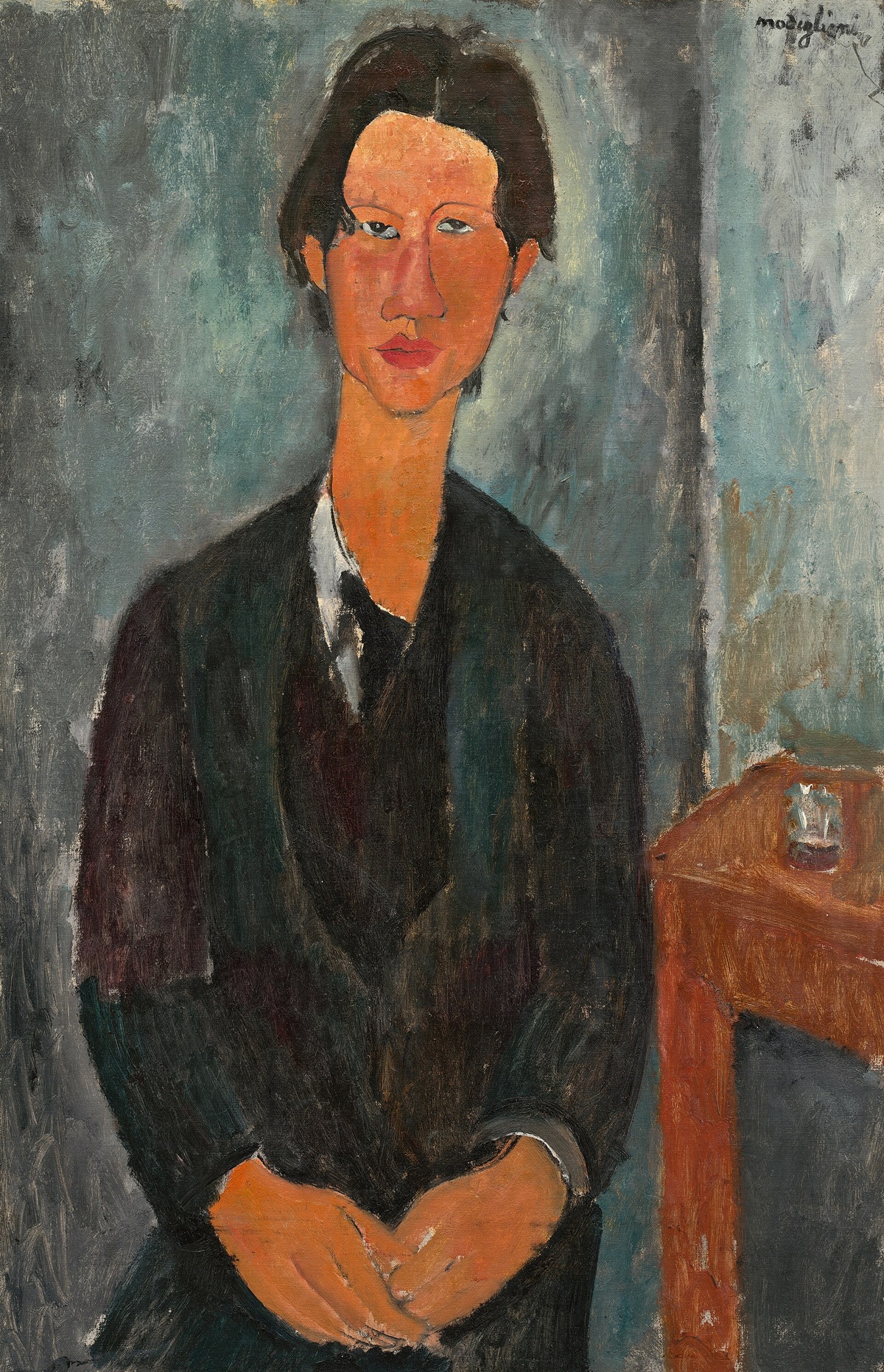
It was strange that the Italian painter Amedeo Modigliani–cultivated, suave and handsome, urbane, polished and multi-lingual—should befriend this irascible man who carried his misery like a hunchback and antagonized everyone else. But Modi (as everyone called him) was himself impoverished, alcoholic and tubercular. The first to recognize Soutine’s genius and advance his career, Modi sympathized with his self-denial and sacrifice for art, and tried to civilize the barbarian by teaching him table manners and personal hygiene.
In one of Modi’s sympathetic portraits of 1915, Soutine’s close-up head nearly fills the frame and looks straight out at the viewer. His high thick hair falls over his ears; his brown eyes with tiny dots of white are asymmetrical; his nose is broad and spade-like; his lips, parted in a hesitant smile, show white teeth; his head is supported by a long column of neck. Revealing Soutine’s naiveté and intensity, his sensuality and peasant strength, Modi compassionately portrayed him as an amiable country bumpkin rather than as a tortured soul.
In his grotesque self-portrayals, Soutine (unlike Modi) exaggerates his own ugliness and looks like the village idiot. His Self-Portrait is a grotesque caricature of his unusually crude and ugly face. Sitting sideways and turned toward the viewer, he wears a hideous greeny-yellowy jacket with a high round shoulder and an elongated right arm. He has thick pasted-down dark hair, one black and one obscured eye, a huge nose that juts out like a clown’s, thick protruding lips and battered boxer’s ears. The American critic Maurice Tuchman called this study in humiliation, “a pitiless, ruthless mask, ridden with self-contempt.”
Soutine didn’t want anyone to watch him work, fearing they might steal his artistic secrets. He painted directly on the canvas, without preliminary sketches, and often finished the picture in a creative spurt of one hour. Constantly moving from place to place to seek inspiration, he’d paint in a fury, then suddenly stop working for several months. Soutine imitated Rembrandt’s Slaughtered Ox and Woman Wading in Her Bath, and Jean Chardin’s The Ray. He had the emotional intensity of Van Gogh, Edvard Munch and Egon Schiele, and influenced the abstract fury of Willem De Kooning.
Soutine’s vertiginous landscapes look as if the earth were heaving convulsively during a quake. His people are distorted, twisted and miserable, as if suffering from an epileptic seizure or suddenly stricken by a fatal disease. Most of his subjects were horrified by his portrayals, or betrayals. His dead animal models—pheasants, fish and oxen— rotted and stank, and he drenched the flayed beasts with buckets of blood to retain their color. But they were good subjects who never moved nor asked for a fee. His morbid animals recalled the butcher’s ritual slaughter in his village and the dead soldiers in war, who matched his tormented vision of life.
In 1923 Dr. Albert Barnes began to buy Soutine’s paintings for his private museum outside Philadelphia, and eventually acquired 59 works. After a long struggle with poverty, Soutine suddenly became rich. Starting in 1924, the former ape-man spent vast sums on manicures, silk ties and English suits. The deformed was transformed, but remained sick, suspicious, paranoid and fearful. He’d been furious when he was poor and was still furious when he became rich. He declared, with considerable exaggeration, “They used to leave me starving, but now, because people know my name, they come to lick my boots.”
Late in life he had, surprisingly, two lovers who adored him: Gerda Michaelis, a German- Jewish refugee in France, and Marie-Berthe Aurenche, a sometime model and former wife of the Surrealist painter Max Ernst. Soutine also had an illegitimate daughter (“apparently I have a child,” he casually remarked) whom he’d abandoned and never saw.
During the German occupation of France, he acquired false papers, managed to hide in the countryside and survived the Gestapo’s wartime hunt for Jews. But in August 1943 he had a severe attack of bleeding ulcers (possibly stomach cancer). He could not get proper medical treatment in a small village, took more than twenty-four hours to reach a doctor in Paris and died on the operating table.
Soutine left no archive of his papers and wrote only a few impersonal business letters in illiterate French. Celeste Marcus’ disappointing biography Chaim Soutine (Public Affairs, 2025. 295p. $34) is based on familiar material in printed sources. Weirdly structured and repetitive (she mentions his “energy” about 20 times), the book has several digressions that abandon Soutine for as long as 8 pages. The last 70 pages of text, which come after his death, are mainly arguments with and padding from other critics. Marcus’ comments on Soutine’s style range from simplistic: “he remade himself with every brushstroke”; in his animal pictures “the beast hums but does not stir,” to obfuscating: “Soutine’s later paintings are astonishingly cohesive, by which I mean that each one looks like a single organism.” She concludes with her own physiological response to his work: “my head trembles in a particular prickle.”
The errors missed by the editors are abundant: Versailles is misspelled; there was no institution in Paris called “Popular University”; Soutine’s father was a clothes mender, not a “mender”; Wassily Kandinsky was not Jewish; Manet was not “Paris’ ur-rebel,” but a respectable and distinguished gentleman; Henri Matisse was not “thrown out” of the Ecole des Beaux-Arts, he was never admitted; mountain air, not sea air, “was thought to be the best cure for tuberculosis”; Samara is 1,600 kilometers east, not west, of Vilna; the mother of Modi’s lover was not “priggish” but wise in her disapproval of their liaison. The impoverished Modi had an illegitimate child with Jeanne Hébuterne, who was pregnant again when she committed suicide right after his death.
Soutine’s work bears the imprint of his warped character. The anthropomorphic Still Life with Rayfish shows a wretched creature standing upright and unsupported, with its dangerous sting-tail hidden. It has a pointed head, drooping eyes, open mouth and wide wing-like supplicating arms. The red in the fish is accentuated by the tall red spoon in a white jug and by the jumbled pile of twelve blood-red tomatoes on a wavy cloth. This tragic triangular fish, sad to be caught and soon to be eaten, has an anguished and tormented human expression.
His portraits are equally striking. Pastry Chef portrays a young man with a large forehead, high wing-like asymmetrical ears that could carry him aloft in a breeze, drooping eyes, long thin nose, pursed red lips and narrow pointed Fred Astaire chin. He’s seated in a fragile wooden chair that seems about to collapse. He wears a tilted white cap adorned with a cloudy top, and is trapped in a huge billowing white uniform with broad square shoulders, buttoned on the left side. His hands, extending out of the puffy sleeves and holding a red handkerchief, are folded on his lap. Exhausted and miserable from overwork, he looks about to collapse.
Bellboy at Maxim’s captures a hotel servant with a flat red cap on his black hair and tilted head, dressed in fiery red uniform with shiny gold buttons down the center of his jacket. His right shoulder, as if crippled, is jerked high above the left side. His eyes are heavy-lidded and blackened like a blind man, his nose and ears are warped. He sports a small square Hitler mustache and a narrow chin gripped by a high tight collar. He sits with thin legs apart, knees sprawled and fingers twisted on his hips. His crotch and bent elbows encase his meager torso in three triangles, and he seems sadly enslaved and resigned in his costume.
Soutine’s grotesque, tilted, convulsive distortions express his misery and produce in the viewer what Immanuel Kant called the “negative pleasure” of vicarious suffering.
Jeffrey Meyers has published Painting and the Novel, Impressionist Quartet, biographies of Wyndham Lewis and Modigliani, and a book on the Canadian realist painter Alex Colville.
The Biographer’s Quest appeared with Mercer University Press in April 2026.



.jpg)
Be First to Comment