
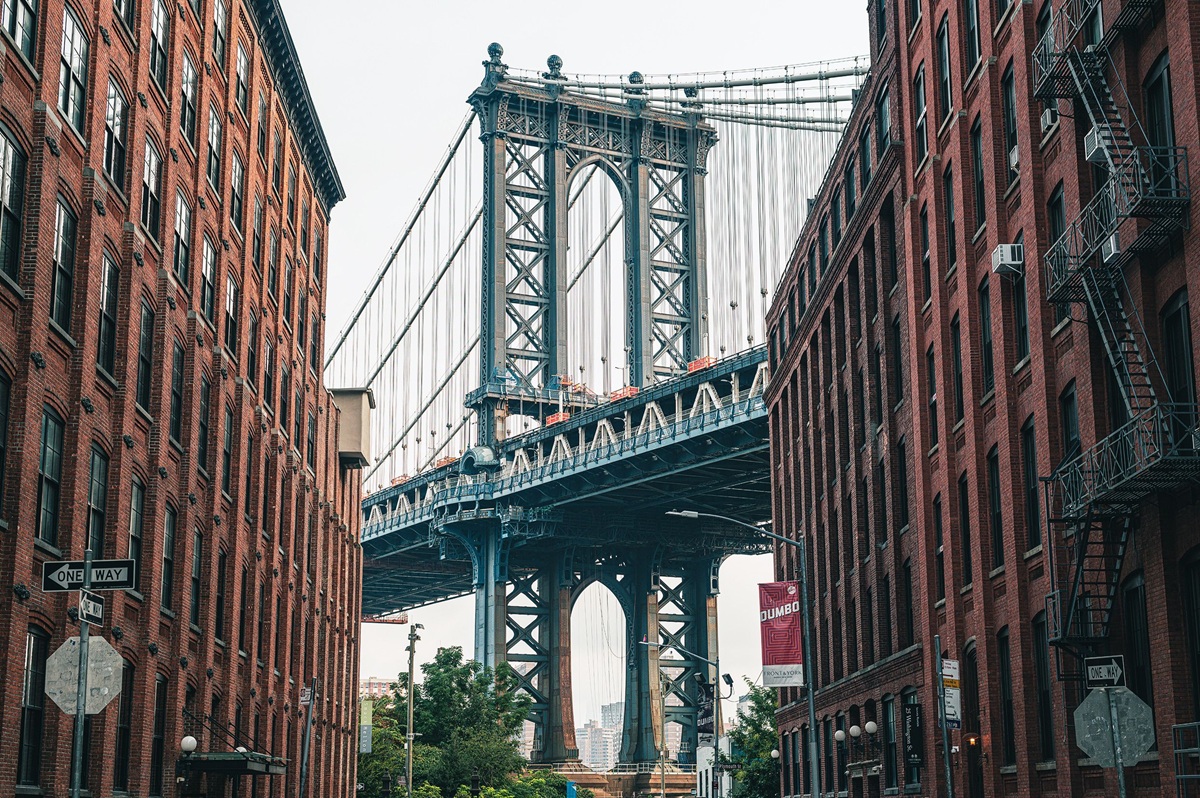
Ulysses in Brooklyn
By Martin H. Levinson
The streets of Williamsburg were teeming with twentysomethings typing on their phones. Leopold Bloom Jr.—the great-grandson of Dublin’s most famous day-tripper—stood on the platform of the Bedford Avenue L station. He adjusted his canvas tote bag, stitched with a vintage vinyl record shop logo, and checked his messages. The train was six minutes late. An eternity. A preview of Hades.
“The New York City transit system is a soul-sap,” Leopold mused, staring into the darkened tunnel where rats darted playfully among the third rails. He imagined himself as a parched Lawrence of Arabia atop a camel by a recently closed Starbucks in the Syrian Desert. Around him, the chorus of the damned—commuters and college kids wearing noise-canceling headphones—shuffled their feet. They stared into glowing screens, seeking salvation from their social media feeds.
When the train finally roared into the station, Leopold fought his way through the closing doors. He wedged his body between a man screaming end-of-the-world forecasts and a woman eating a smashed chickpea whole- wheat salad pocket from a paper tray. The heat was unbearable; they were protoplasmic pizzas trapped inside a 400-degree metal oven. Leopold silently prayed the prayer of an atheist who, if he were religious, would pray to a God he knew existed. Why had he left the Midwest to come to this Sodom and Gomorrah? Was it because almost everyone there looked alike, talked alike, and thought alike? That was, like, a possibility. But he was a man with a plan and that plan was to make it intact to his destination: a TV studio in Dumbo where he would record a TED talk on garbology, the academic study of modern refuse and waste to understand contemporary human culture.
He got off at York Street, leaving the station for Dumbo’s treacherous and uneven cobblestone streets, designed by a coterie of negligence lawyers to twist the ankles of anyone wearing anything less sensible than a $700 pair of trail-running shoes.
The talk went well. However, when he finished, he was overcome with an intense craving for something more substantial than food for thought. He wanted food to eat. But where to go to satisfy this deep, gnawing void that he felt would not be placated by ordinary sustenance? And so began an epic quest.
After taking the ferry from Dumbo to Greenpoint, he found himself standing outside Privilege Pies, a bakery famous for its twenty-four-hour devotion to serving inclusive, violence-free muffins; hate-free, hole-free bagels; and slices of pie determined by one’s societal advantages. The line stretched across Newtown Creek into Long Island City, a serpentine monster containing mostly high-income young people and creatives.
“Must endure,” Leopold muttered to himself, as he looked at his banking app. “The checking account is vacant, but the ego is fully funded.”
He waited an hour and forty-five minutes. When he finally reached the counter, the barista—a young, extensively pierced individual with an aura that said “I’m completely exhausted by the weight of existence”—stared through him. She was the Circe of the harbor, turning grown men into swine for kicks.
“Can I get a flavor-free cardamom knot?” Leopold asked, his voice trembling slightly.
“Knot happening,” she said in a flat monotone. “We only have flavor-free virtue-signaling popovers and flavor-free anti-Israel scones.”
Defeated, Leopold ordered a popover. It cost sixteen dollars. He chewed it on a park bench overlooking the water, watching the clouds turn a whiter shade of pale. The popover tasted slightly of a loaf gone bad and no hope of ever gaining steady employment. He thought of his wife, Molly, who was currently at home in their 350-square-foot studio apartment in Bushwick, likely ordering a far better lunch through DoorDash while texting her paramour, an energetic and cocky AI bot about town named Boylan_Beta_v2, whom Molly had met on OkCupid.
The afternoon dissolved into a blur of Zoom meetings and interactions on X, digital tempests where much was communicated but little was said. Circle back. Value-adds. Deliverables. Move the needle. Leopold nodded along, his mind turning to ancient texts he had dodged reading in college, wondering if Odysseus had ever faced a challenge as grueling as aligning cross-functional stakeholder expectations for a Q3 paradigm shift.
By six in the evening, the sun was sinking behind the Manhattan skyline, casting a golden hue over skies polluted by smoke drifting in from uncontained wildfires in Canada. The final trial awaited him: the journey home.
He decided to Uber back to Williamsburg, a ten-to-fifteen-minute car ride under normal conditions. But the Traffic Gods had other things up their celestial sleeves, namely a 14-car pileup on the Brooklyn-Queens Expressway that turned his commute into a nightmare.
When he finally stumbled through the door of his apartment at 11 p.m., he was bone-tired and his body ached. Molly was lying on the couch, spent from watching TikTok videos and feeling guilt about getting it on in the apartment with Boylan_Beta_v2 seven hours earlier. The blue light of the television washed over her face.
“How did your day go?” she asked without looking up.
Leopold hesitated, crushed by the ontological dread of a cosmic explorer. He had journeyed to the absolute precipice of human understanding, only to return to civilization with nothing to show for it but a half-eaten popover and notifications full of hostile X-post exchanges.
“I have scrolled through the timelines of many men,” Leopold said, collapsing onto the rug beside the couch. “And I have suffered much in the deep, dark corners of an X thread.”
“Cool,” Molly replied. She poured herself a glass of Killer Kombucha and picked at a piece of peeling laminate on the kitchen island. “Can you take out the recycling? It’s cardboard night.”
Leopold, looking up at the water-stained ceiling of his pricey pint-sized domain, closed his eyes and thought, I wonder if Molly is ready to have a monogamous relationship with me. Molly, operating on pure narrative convenience, read his mind and responded with the iconic closing words of an unpunctuated stream-of-consciousness soliloquy that her namesake utters in James Joyce’s celebrated 1922 masterpiece: yes I said yes I will Yes. Leopold felt gratified and relieved Molly had finally chosen him over an AI Casanova, so with hopes for a better world where subways run on time, pastry prices are not going through the roof, and where the study of garbage is seen as crucial to figuring out modern society, Leopold said, “Great, let me get the recycling.”



Be First to Comment