
The Titans
Jeffrey Meyers
William Wallace. Michelangelo & Titian: A Tale of Rivalry and Genius. Princeton UP, 2026, 198p, $35. 48 color plates, 49 black-and-white.
In their parallel lives of admiration and rivalry, artistic assimilation and reciprocal creativity, Michelangelo (b.1475) and Titian (b. 1488/90) met twice: in Venice in 1529 and Rome in 1546. In his learned, lively and readable book, William Wallace explains that “our story must be largely reconstructed from scant documentation.” He imaginatively reconstructs Michelangelo and Titian’s knowledge of each other’s work from accounts of their contemporaries and engravings of paintings they had not actually seen. He also asks but does not answer many questions: “How much of this collaborative activity can be credited to Michelangelo’s encounters with Titian?” and “Was Michelangelo consciously or unconsciously absorbing the inventions of his contemporary rival?”
Wallace mentions Titian’s inventive, glowing, vivid, vibrant, metallic, lustrous and captivating “colors” more than 20 times, but doesn’t analyze how he used them, and includes several boring lists of obscure names. He is also maddeningly repetitious. On page 104, for example, he repeats three times that Michelangelo gave the pope gifts of Trebbiano wine and four times that he was the pope’s regular dining companion. He repeats Michelangelo’s false and misleading statements: “painting is not my métier” and “too bad the Venetians never learned to draw.” The reader suspects that Wallace has taken many bits from his previous books and failed to integrate them into this text.
Many of Wallace’s comparisons, an attempt to link the two artists, are far-fetched and unconvincing. Though both figures are seen from the back, the languid musician in Titian’s bedside seduction, Venus and Cupid with a Lutenist, is not at all like Michelangelo’s uncomfortably twisted Libyan Sibyl in the Sistine Chapel. Titian did not have Michelangelo’s “awesome” and “awe-inspiring,” but quite distinct, statue of Moses in mind when he painted Doge Andrea Gritti. The blurry decapitated head in Titian’s Judith and Holofernes does not “bear a striking resemblance to the woodcut portrait of Michelangelo,” nor does it “also bear some resemblance to Vasari’s self-portrait.” The central figure in Titian’s Pietà is very different from Michelangelo’s marble statue of this traditional religious subject. When comparing the artists’ Annunciations, Wallace admits, “of course, there are many significant differences.” His thinking is more wishful than artful. As a fully mature artist, Titian did not require gratuitous inspiration. Since Titian was exclusively a painter, and Michelangelo primarily a sculptor and architect, the younger Venetian had a greater influence on the older Florentine’s paintings.
It’s worth concentrating on three of Titian’s best paintings. Wallace quotes Michelangelo’s flattering but false statement that his patron Paul III was “a good and holy man,” though this pope was notorious for fathering several illegitimate children, outrageous nepotism and squandering papal funds on art. In Pope Paul III and his Grandsons (1546) Titian expands Raphael’s monumental and authoritative figure of the aged and contemplative Pope Julius II (1512) into a tense, melodramatic and revealing domestic drama. The blood-red tablecloth and the pope’s heavy red velvet cape contrast to the white gown and open ermine sleeve of the seated, bearded and beaky-nosed 78-year-old Holy Father. Both grandsons are in their 20s. Ottavio Farnese, the younger brother, wears white tights and dark tunic and carries a sword. Portrayed in profile, he assumes the correct cringe before the stony gaze of the wily old pope. Alexander Farnese, the older, bearded and favored grandson, dressed in a cardinal’s hat and robe, raises his right hand to warn the pope about the ingratiating words of his competitor and rival. Alexander did not succeed his grandfather and was forced to remain celibate; the successfully scheming Ottavio married the daughter of the Emperor Charles V.
Wallace redeems himself with excellent brief analyses of two other paintings by Titian. In Danaë, based on Ovid’s myth, the virgin princess, knowing that Jove is about to assault her, is both eager and fearful. Wallace writes, “Naked except for a pearl earring, jewel-studded bracelet and pinky ring, Danaë reclines against a hillock of downy pillows. While gazing dreamily toward Jove who materializes as a shower of golden coins, she sinks further into the soft, disheveled bed. A bit of white sheet prevents us from seeing what Jove spies: her pudenda, revealed as her legs fall open, welcoming the divine copulation. Unconsciously, Danaë grips the rumpled sheets in anticipation of the pain and pleasure of union with the deity.” The winged “Cupid turns away in alarm while lovely Danaë yields to divine lovemaking.”
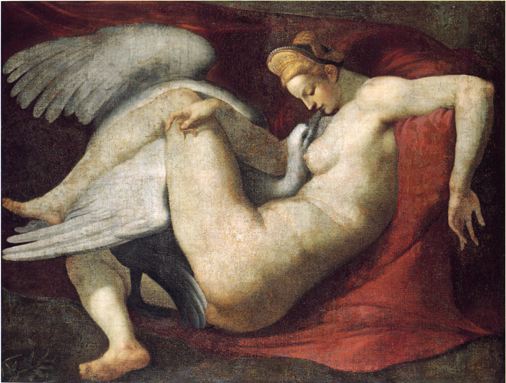
In Michelangelo’s Leda, a similar myth, Jove takes avian form to couple with the acquiescent Spartan queen. The swan’s horny beak presses against Leda’s lips as her left arm hangs limply down in the luxuriant red drapery. Wallace observes that her index finger “directs our attention to the titillating foreplay taking place in the shadowed area of Leda’s pudenda. A soft, feathery wing brushes her fleshly thigh and expansive bottom prompting Leda to wrap her leg around the soft fluttering wing, assisting and encouraging Jove’s penetration” (repetition noted). But Wallace ignores an essential element in the picture that undermines the sensuality. Beneath the swan’s white wing, the bird’s black underbelly, pointed black feathers, stilt leg and webbed feet, press horribly between Leda’s massive thighs and open legs. Titian portrays the seduction of a sensual nude; Michelangelo portrays a rape of a stone-like woman. Wallace does not comment on how Michelangelo’s homosexuality affected their personal relations. In “Leda and the Swan” Yeats asks the crucial question: “Did she put on his knowledge with his power. / Before the indifferent beak could let her drop?”
In The Miracle of the Jealous Husband, a murderous scene, Wallace notes that “Titian painted a swarthy, bearded, [long-haired] and bedraggled husband violently yanking the hair of his collapsed and pleading wife, exposing her neck and half-naked breast to the long dagger that he is about to plunge into her innocent flesh. The rust-red [vertical] stripes of the husband’s belted tunic [enhanced by his blood-red and white checkerboard sleeves] anticipate the streams of blood that are beginning to stain his wife’s white chemise and lemon-ochre dress. In her vain appeal, she raises her hand to deflect the brutal final [sexual] thrust.” In the background, beneath a stormy sky and wind-torn trees on a steep cliff, St. Anthony absolves the repentant husband.
Wallace omits “Miracle” in the title and doesn’t note that St. Anthony miraculously revived the dead wife. The jealous Othello, just before killing the innocent Desdemona who could not be revived, exclaims: “Yet she must die, else she’ll betray more men. / Put out the light, and then put out the light.” This book confirms that Titian is the greatest painter of all time.
Epilogue: A similar encounter took place a century later, from September 1628 to April 1629, when Rubens (b.1577) met Velázquez (b.1599) during the Flemish painter’s diplomatic visit to the Court in Madrid. Velázquez showed Rubens his pictures as they walked together through the Royal Palace. Madlyn Kahr writes that “Velázquez would have accepted the superior status of the older, world-renowned Rubens, and would have welcomed the opportunity to learn from him. . . . Rubens was knighted by Philip IV in 1629; Velázquez henceforth labored toward the same goal in order to escape the galling inferiority of his rank.” As with the Italian painters, there was no one on the scene to record their precious conversations.
Jeffrey Meyers has published Painting and the Novel, biographies of Wyndham Lewis and Modigliani, Impressionist Quartet and a study of the Canadian realist painter Alex Colville.


Be First to Comment