
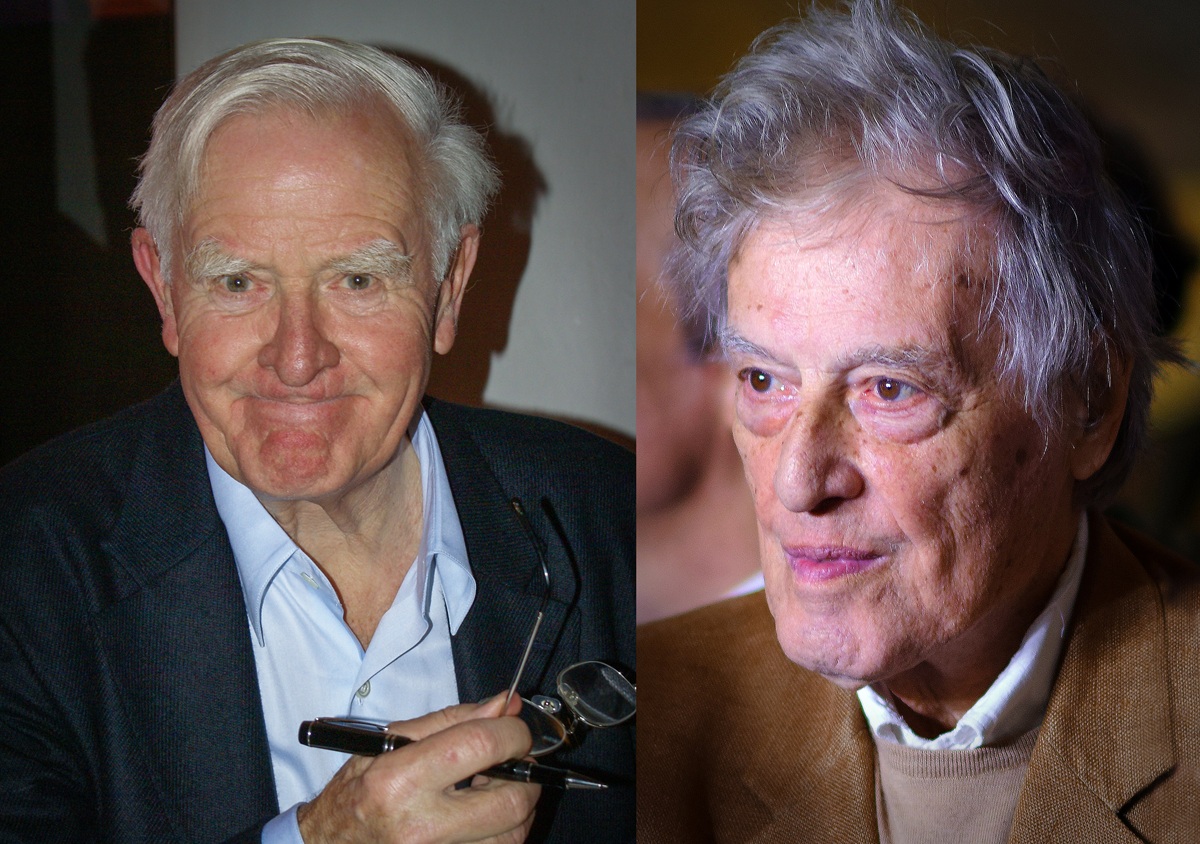
John le Carré and Tom Stoppard: A Friendship
Jeffrey Meyers
John le Carré (whom I call LC), born in Poole, Dorset in 1931 and educated at Oxford, was six years older than Tom Stoppard. He was born in Zlín, Czechoslovakia and schooled in Darjeeling, India, where his stepfather was stationed. LC was born David Cornwell; Stoppard was born Tomás Sträussler. LC’s mother abandoned her son when he was five years old; in 1942, when Stoppard was five, his doctor-father died at sea after his ship was bombed by the Japanese. Stoppard mourned his father’s death; LC rejoiced at his death of his father, a charismatic criminal. Stoppard began his career as a journalist; LC began his career as a spy. LC had two wives and four sons; Stoppard had three wives and one son; both had complicated liaisons with several lovers. Stoppard loved the glittering social life; LC kept his head below the parapet. LC refused a CBE; Stoppard accepted a knighthood and the Order of Merit. Their close friendship —with no rivalry nor envy—was based on intuitive sympathy, generous encouragement and sincere respect.
The edition of LC’s Letters, edited by his son Tim Cornwell in 2022, contains seven long, intimate and sometimes emotional letters to Stoppard. Tim writes that “Stoppard and Le Carré had exchanged warm correspondence in the 1990s, but the bond grew stronger in le Carré’s later years.” Nevertheless, LC’s biographer Adam Sisman, and Stoppard’s biographer Ira Nadel, do not discuss the close bond that was important to both major authors.
They met in 1989 when Stoppard was writing the screenplay based on LC’s novel The Russia House. When LC suggested revisions to the screenplay, Stoppard sharply asked, “Are you telling me how to write a script?” In the end, however, LC was pleased with the faithful narrative and felt it was “an enormous homage to my words.” He immediately found Stoppard enchanting and extremely intelligent. Their correspondence began on February 4, 1999 when LC praised Stoppard’s film Shakespeare in Love: “it’s one of those perfect, lighthearted, profound works of art that actually increase the public’s awareness of its own cultural heritage.” He ironically claimed to identify most naturally with the boy John Webster, future dramatist of the gory Duchess of Malfi, who feeds a wriggling mouse to a starving cat.
On October 27, 2014, always severely critical of his own work, LC wrote Stoppard that he’d regretfully abandoned a completed novel. He “wasn’t convinced by it, wasn’t moved, revisited too many old themes,” and called it “a mis-application of energy & two years’ work.” Trying to console him for the wasted time and serious loss of valuable material, Stoppard stressed the positive aspects of the crisis: “I felt for you without knowing what to feel—but ultimately admiration for strength of mind, I think, qualified by regret that—undoubtedly—so many treasurable beautiful” things had been lost.
In February 2015, LC sent Stoppard a draft of a play about his con-man father, Ronnie Boy. Stoppard tactfully ignored the faults and encouraged him by replying, “The play is marvellous and an easy read, so speedy and full of fun, a real pleasure.” His friend had admirably freed himself “from the supposed constraints of theatre and theatre narrative.” LC had a lot of trouble trying to get the play produced at the Almeida Theatre in North London, where the director delayed replying and then went silent. LC furiously wrote, “Rejection, disappointment, etc., we handle as part of the job, but opaque silence is no way to communicate & it pissed me off in the way bad manners do.” He hoped his sons’ company, the Ink Factory, would produce the play, but it was never performed nor published.
As their friendship developed in the 2010s, the two authors exchanged drafts of their novels and plays, and offered each other expert advice. As LC’s novels declined and he lost confidence, Stoppard sent helpful analysis of A Legacy of Spies. In June 2017, LC appreciatively responded: “It was wonderful to have your help, & I shall always be grateful for it. Thank you once again, so much. Our love to you both, & let us meet soon.”
When searching for his next subject in December 2017, LC felt “pretty desperate from all the waiting and not finding.” Self-critical as always, and alluding to Budd Schulberg’s novel What Makes Sammy Run?, he added, “Nothing I’ve written withstands my own scrutiny, which I suppose is what makes Sammy keep running.” Obsessed as always with his fantastic swindling father, he confessed, “my papa worked several Maharajahs in his time, and conned his way into the confidence of a Maharajah of Dhrangadhra, obtaining for himself a little palace on the estate from which he pursued his ambition to open a football [betting] pool in the subcontinent.”
LC expressed dissatisfaction with the televised version of his novel The Little Drummer Girl. He then effusively and modestly thanked Stoppard for “the much-needed revision to Agent Running in the Field, “prompted, I have to say, almost exclusively by your generous & extremely precious editorial suggestions. . . . We think of you both constantly, and always with the greatest fondness. And I shall be forever in your debt for the loving care—also tough care, thank heaven —that you devoted on my novel: not for the first time.” In January 2019, two weeks later and the year before his death, he reported with gallows humor the cancer that would soon kill him: “my oncologist asked me ‘how much do you want to know?’ and if I’d had your presence of mind, I wd have replied, with you, ‘nothing that might ruin my week.’ ”
Le Carré hoped to die with a pen in his hand. In July 2020, five months before his death, he returned to his most famous character and mentioned the crucial questions he planned to answer in his latest project: “Smiley finally decides he is ready to meet his old nemesis, Karla, settled under another name with his mentally sick daughter. What vision, if any, do they now have in common? Who will be the leading voice in the (theoretically) post-ideology world, what is doable, what is the pie in the sky?” He then switched to his wife’s tests and treatment for her potentially fatal breast cancer. LC concluded by responding to Stoppard’s current project about the atomic bomb. I would start “when Einstein spots the scale of anti-Semitism in Berlin and jumps ship, never to return. I love the notion that the Germans delivered the world’s best brains to the Allied powers, Einstein among them.”
Stoppard’s biographer Hermione Lee concludes that LC (emphasizing Stoppard’s loyalty) saw him “as hugely courteous, iron-hard when needed, universally sympathetic and generous, incapable of betraying a friend. He loved what he called his ‘whizzy creativity.’ Culturally, he found him very ‘mittel-European.’ conservative with a small ‘c,’ with an outsider’s love of England. He felt they were kindred spirits.”



Be First to Comment