
Terribly Hush-Hush
Review by Jeffrey Meyers
Robert Verkaik. The Writer and the Traitor: Graham Greene, Kim Philby and the Great Betrayal.
London: Headline Wellbeck, 365p, £22.
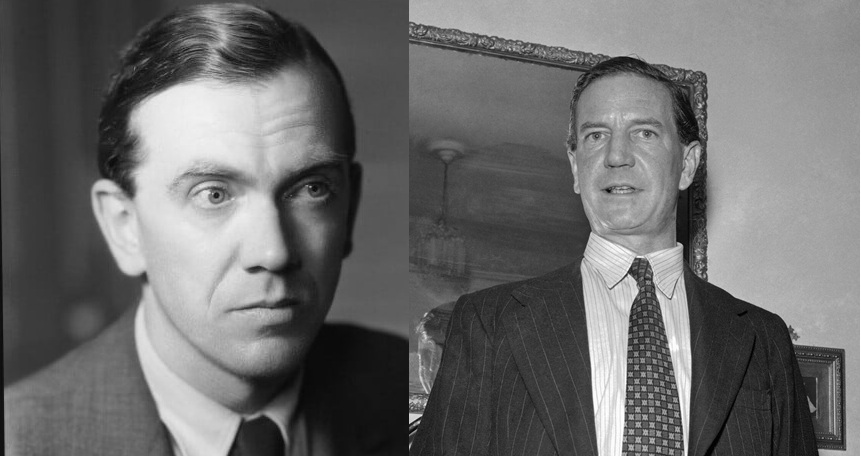
Graham Greene (1904-91) worked as a British wartime spy in London, West Africa and Lisbon from 1941 to 1944. The younger Kim Philby (1912-88), a spy from 1934 until 1963, was Greene’s colleague and chief for 19 months. In this serious book based on extensive research, Robert Verkaik describes their lives in alternating chapters. Philby was a bon viveur who bought a London taxi, wore a cabbie’s flat cap, and drove friends around to clubs and pubs. He was also the most successful Soviet spy and penetrated the highest levels of British intelligence. He sent his secret agents to certain death in wartime Albania and gave the Allied D-Day plans to the Russkies. Finally unmasked in 1963, he fled to Moscow and died there.
Like T. E. Lawrence in his fatal crash, Philby rode a powerful Brough motorcycle and had many narrow escapes. During the Spanish Civil War, when his car was hit by a Russian shell that killed four of his companions, he was the only survivor. But this incident did not make him what Verkaik calls “the hero of the Spanish Civil War.” Verkaik adds that as early as 1946, “beneath the smooth charm and sangfroid of the Soviets’ most valued double agent, there was also a growing fear that his enemies were closing in for the kill.”
As a spy, “Greene was extraordinarily intuitive, with a razor-sharp ability to dissect character and divine geopolitical moments.” He was equally incisive about his own emotional life. Involved with two 1overs, Greene sent his estranged wife Vivien a shrewd analysis and defense of his own character: “by my nature, my selfishness, even in some degree by my profession, I should always, and with anyone, have been a bad husband. My restlessness, mood, melancholia, even my outside relationships, are symptoms of a disease and not the disease itself, and the disease, which has been going on ever since my childhood and was only temporarily alleviated by psychoanalysis, lies in a character profoundly antagonistic to ordinary domestic life.” Greene made a fortune from Hollywood films based on his books, yet was also anti-American and absurdly declared, “I would rather end my days in the Gulag than in California.”
Verkaik agrees with Greene’s biographers that the depressed and pseudo-suicidal author never actually tried Russian roulette. In any case, the weight of a single bullet in the revolver evades the fatal barrel and falls harmlessly into the lower chamber. While training as a spy in wartime West Africa, Greene learned “writing with secret inks or bird droppings if the ink ran out and how to conceal and use a potassium cyanide pill should he be captured by the enemy.” (There was plenty of fowl excrement in Africa, and Hermann Goering used a cyanide pill to escape execution during the Nuremberg Trials.) Greene’s most original idea was to open a brothel in Freetown, Sierra Leone, that would attract foreign spies who could be spied on in medias res. His next post in Lisbon was appropriately code-named VD. Greene satirized spies in his novel Our Man in Havana (1958).
Verkaik has two fatally flawed arguments. Concerned about his superior’s inability to carry out his vitally important job in wartime Sierra Leone, Greene accurately reported to London that his generous, overworked boss, Patrick Brodie, “is now an elderly and very tired man on the verge of a nervous breakdown.” Verkaik states that “Greene was professionally concerned about the threat to the security of British convoys at this critical juncture of the war” and that “the interests of war demanded that Greene sacrifice his old friend.” But he also harshly and mistakenly claims that Greene betrayed Brodie, stabbed him in the back and was treacherous in denouncing him. Verkaik praises Greene’s book The Heart of the Matter (1948), set in West Africa, which describes the moral and religious dilemma of a Catholic police officer torn between his wife and his mistress. George Orwell exposed the fatal flaw in this major novel by stating, “If the hero Scobie believed in Hell, he would not risk going there merely to spare the feelings of a couple of neurotic women.”
Also, since Greene liked and admired Philby, he would not—as Verkaik repeatedly claims—have portrayed him as the diabolically evil Harry Lime in his novella and film The Third Man. Lime’s name (a shade of Greene) suggests slime, quicklime used to bury bodies (Lime was buried twice) and limelight. Lime first appears out of the shadows of a doorway when light from a drawn curtain falls straight across a narrow street and reveals his features. He has deceived and manipulated his friend Holly (alluding to Hollywood) Martins, whose character suggests soft and easily carved limestone. Harry Lime not only sells “diluted penicillin,” he also increases its weight and toxicity by adding the sand that has killed many children suffering from meningitis.
Verkaik convincingly reveals that Harry Smolka—an Austrian journalist, friend of Greene and double Soviet-British agent—influenced the portrayal of Lime. Smolka showed Greene his unpublished story about a villain who sold polluted penicillin. Alexander Korda, the producer of The Third Man film (1949), paid Smolka 200 guineas for his idea. Using his favorite emotional word, Verkaik claims that “Greene betrayed Smolka.” In fact, Smolka received a generous payment, worth £11,600 pounds today, for the use of an idea from his unpublishable story.
The lives of Greene and Philby are very well known, and Phillip Knightley’s Philby: KGB Masterspy (1988) is particularly perceptive. Verkaik’s use of archival material is surprisingly dull and not especially illuminating: “A cross reference of a secret document copied and sent by Philby with the same document secured by another Russian agent revealed that Philby had omitted one important section.”
Verkaik makes several typographical and factual errors. The correct words should be Bedside (not Beside), Dakar (not Dhaka), Narayan (not Naryan), Tagblatt (not Tagblaat). Freetown, Sierra Leone is l,500 (not 2,000) miles from Lagos, Nigeria; l07,000 (not hundreds of thousands) of Allied troops invaded North Africa in November 1942. The biographer Norman Sherry could not possibly have questioned Greene for “thousands of hours.” Christopher Isherwood and W. H. Auden were not communists.
Verkaik’s style ranges from the overheated,
“Hitler’s U-boats presented a very serious danger, and the success of the top-secret operation was hanging perilously in the balance. In a desperate high-risk gambit”
to the overloaded,
“Philby claimed to Elliott that it was his wife Lizy who put him in contact with Arnold Deutsch, who he only knew as ‘Otto.’ Lizy says Philby arranged for Deutsch to meet Philby in Regent’s Park on 21 June 1934.”
The crucial question in this book is why Greene remained loyal to the charming and ruthless Philby. When Philby criticized him, Greene (whose father was a headmaster) became furious and told a colleague, “I’ve just had a caning from the headmaster.” Nevertheless, Philby was Greene’s congenial colleague and drinking companion. Philby was an effective boss; he helped Greene three times when he got into serious trouble at work; Greene admired his intelligence and spycraft, and he was a great mole model.
Greene had a public quarrel about Philby with John le Carré, a former spy. Unlike le Carré, Greene was impressed by the audacity and cunning of Philby’s deception, which lasted—despite the suspicions he aroused—for three decades. Greene admired Philby’s secret sacrifice, le Carré thought it was pathologically evil. Greene believed that personal loyalty was more important than patriotism, le Carré believed in loyalty to his country and to the secret service. Greene’s reasoning was perverse, his tone cool; le Carré’s arguments were logical and incandescent with anger.
Jeffrey Meyers has published Graham Greene: A Revaluation (1990). Forty-Three Ways of Looking at Hemingway came out with LSU Press in November 2025. The Biographer’s Quest appeared with Mercer University Press in April 2026.


Be First to Comment