
Humbert’s Name in Lolita
by Jeffrey Meyers
Nomen est omen
(the name is a clue)
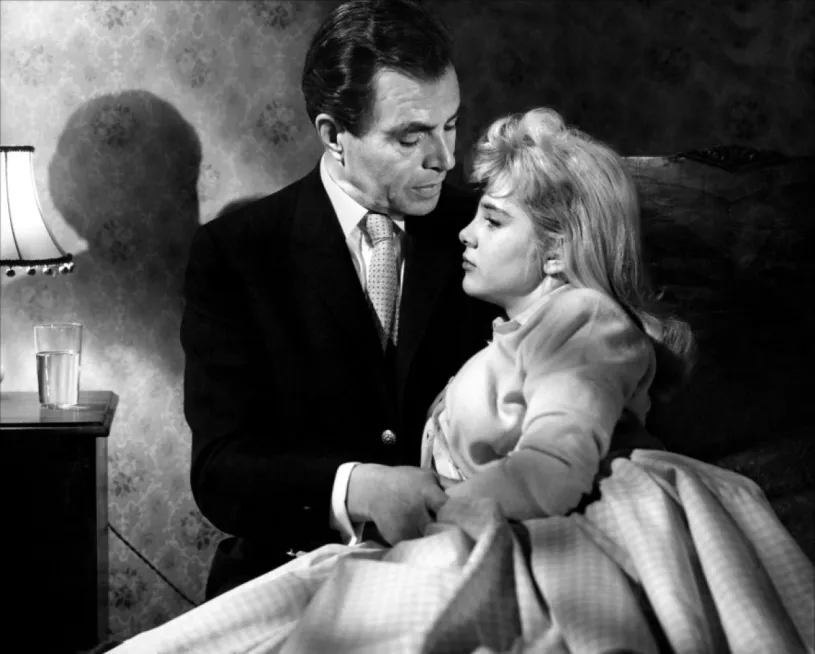
Young nymphets appeared before Nabokov’s Lolita (1955) in the photography of Lewis Carroll, and the art of Egon Schiele and Balthus. The heroine’s formal and familiar names recall Algernon Swinburne’s poem on the literal meaning of “Dolores, Our Lady of Pain” (1866); Lorelei, the mythical siren who lures sailors to their doom; Lola Montez (1821-61), the Irish dancer and mistress of King Ludwig I of Bavaria; and the femme fatale Lola Lola, played by Marlene Dietrich in Josef von Sternberg’s film The Blue Angel (1930). Like Lolita’s stepfather Humbert Humbert, Lolita’s real father and Charlotte’s late husband Harold Haze recalls the alliterative Harry Houdini and Hermann Hesse. Charlotte’s maiden name, Becker, rhymes with pecker. Charlotte Russe, a gooey dessert, alludes to Nabokov’s homeland. In Goethe’s Sorrows of Young Werther (1772), Charlotte drives the hero to suicide. In Lolita, Humbert is caught in Charlotte’s Web, the title of E. B. White’s novel, published three years before Nabokov’s.
The comic and serious names of Humbert Humbert, mirror images that evoke the theme of the double, are more allusive, subtle and complex. Nabokov’s own names are the repetitive Vladimir Vladimirovich. His last novel is subtitled Ada, or Ardor (1969). There’s no letter H in Russian, Henry is spelled Genri, so Nabokov slyly stresses it in English. The initials of Hatter and Hare, Haigha and Hatta in Alice in Wonderland lead straight to Humbert. The River Humber appears in Andrew Marvell’s poem to his Lolita-like “Coy Mistress.” As the entomologist Nabokov well knew, Umber, encased in Humbert’s name, is a brownish-grey moth with coloring that resembles a tree bark. Like Humbert, it protects itself by concealing its true nature. Humbert also suggests the shadowy French ombre. Like Charlotte and Lolita Haze, and Quilty’s Quilt, the surnames provide useful cover and allow them to hide. But Clare (clear), the guilty Quilty’s first name, is also the opposite of Haze.
When he published Lolita, Nabokov was accused of salacious sympathy with Humbert. In his Playboy interview he puns on the names Humbert Humbert and distances himself from any positive feelings about his intriguing character: “The double rumble is, I think, very nasty, very suggestive. It is a hateful name for a hateful person. It is also a kingly name, but I did need a royal vibration [repetition] for Humbert the Fierce and Humbert the Humble.” Each double-Humbert name represents a conflicting side of his ambiguous humbug-humble character. The pseudo-paternal imposter is both a predatory pederast and, more likely, a cringing criminal dominated by the “corrupt and complaisant” Lolita. She can expose and punish him whenever she wishes and threatens him by declaring: “You know perfectly well what will happen and where you will go if the police find out about things.” Lewis Carroll’s Alice precisely foreshadows Lolita’s ambivalent and constantly changing attitude toward Humbert: “I love my love with an H because he is Happy. I hate him with an H because he is Hideous.”
The learned Nabokov was well aware of the negative historical and multilingual associations of Humbert. The Italian kings he alludes to—Umbert Umbert—both ended badly. Umberto I (1844-1900) was assassinated. His grandson Umberto II (1904-83) was deposed and forced to leave Italy when the monarchy was abolished in 1946. The impoverished, lonely and sad hero in Umberto D., Vittorio De Sica’s superb film (1952), is named after the doomed Italian kings. The amiably named French General, Jean-Joseph Amable Humbert (1767-1828), led a failed invasion of Ireland in 1798 to support the Irish revolution. During his 1850 visit to Egypt, Gustave Flaubert discovered a business card from his Rouen hometown floor polisher, “Humbert frotteur,” humorously pinned to the top of a pyramid by his traveling companion Maxime Du Camp. Frotteur also means masturbator, which suggests the vice of the highly-sexed but discriminating Humbert before he met Lolita. Julian Barnes mentions this incident in his novel Flaubert’s Parrot (1984). The Académie Humbert on the Boulevard de Clichy in Paris held art classes for young ladies before the 1914 War. Marcelle Humbert was the pseudonym of Picasso’s lover Eva Gouel (1885-1915) whose early death shattered the artist.
Humbert Humbert, the suave continental, deceives Charlotte to gain access to Lolita, but is himself deceived by Lolita’s apparent innocence, by the diabolical disguises of Quilty who pursues, torments and threatens to expose him, by Lolita’s escape from the hospital with Quilty, and by Humbert’s hope that the married and pregnant Lolita will abandon her husband and run away with him. All the main characters die at the tragic and cruel conclusion of the distressing, disturbing, desolating alliterative Lolita: Charlotte Haze is knocked down and killed by a car, Quilty shot by Humbert, Lolita as well as her stillborn baby in childbirth, Humbert of a heart attack in prison while writing his confession and waiting his trial for murder.
Jeffrey Meyers, FRSL, has had thirty-three books translated into fourteen languages and seven alphabets, and published on six continents. Forty-Three Ways of Looking at Hemingway came out in November 2025. The Biographer’s Quest appeared with Mercer University Press in April 2026.

Be First to Comment