
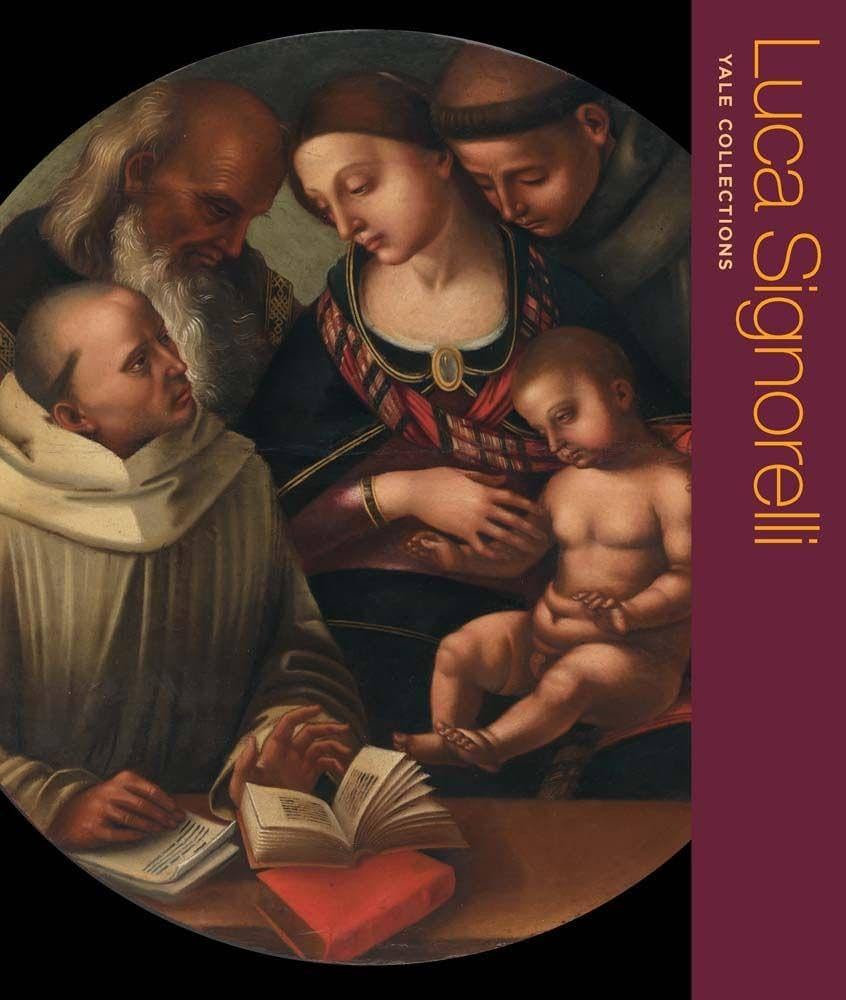
Luca Signorelli: A New Masterpiece
Jeffrey Meyers
Laurence Kanter. Luca Signorelli: A Renaissance Tondo Recovered. Yale, 2026, 111p, pb $25.
In Lives of the Artists (definitive edition 1568), Giorgio Vasari writes that Luca Signorelli (1445-1523) “was more famous in his day, and his works were held in higher esteem, than any other previous artist no matter the period, because in the pictures he painted, he demonstrated how to execute nude figures, and how, although only with skill and great difficulty, they could be made to seem alive.”
At Sotheby’s in January 2020, the Yale University Art Gallery bought a workshop copy of Signorelli’s Virgin and Child with Saints for $60,000. The curators removed several coats of discolored varnish and discovered that it was a genuine Signorelli—now worth more than $1 million. Kanter’s short monograph focuses on the artist’s career in the final years of the fifteenth century. He concentrates on the Orvieto frescoes—painted by the artist perched on a high scaffold under physically demanding circumstances—which “are universally regarded as Signorelli’s masterpiece.” But Kanter’s learned book is flawed by a deadly academic style: “Support for this second option might be adduced from the uncertainty that attended Signorelli’s initial attempts to manage painted architectural frames in his first two wall frescoes at Orvieto (see figs.1.14-1.15), resolved and standardized only after repetition in three subsequent scenes.”
Two other Signorelli paintings of this period deserve attention. The Martyrdom of Saint Sebastian (1498) portrays the naked, blond, exquisitely beautiful saint, who’s standing on a tree stump that surges through the center of the picture and is pierced by six arrows. Benevolently watched by God the Father, Sebastian lifts his head and raises his eyes toward Heaven. Below him three archers, in colorful shirts and tights, bend over while preparing their deadly bows and arrows. The archer on the left has weird, unrealistic, stilt-like legs that barely support his tall body. Two dark naked men on the left shoot arrows into the saint while a passive crowd observes the spectacle. On the right side, a nun with clasped hands mourns the sainted victim. Behind Sebastian, a group of horsemen with helmets and lances drag another victim to be martyred while some townsmen look down from a projecting balcony. Behind these people, a steep street cuts through strangely tilted white cubist houses that rise toward a streaked blue-grey sky. On top of the hill two ruined buildings mark the end of the pagan regime. Signorelli blurs the focus on the martyrdom by including many other people and events.
Signorelli’s The Resurrection of the Flesh (1501) magnificently recreated two brief passages from the Bible: “the trumpet shall sound, and the dead shall be raised incorruptible, and we shall be changed. . . . The breath came into them, and they lived, and stood up upon their feet, an exceeding great army.” (I Corinthians 15:52 and Ezekial 37:10). In this scene from the Apocalypse, a crowd of naked muscular young men struggle to rise out of their graves and change, fully formed, from spirit to body, burial to freedom, death to life, while rejoicing in their new heavenly existence.
The men, in varied poses, attitudes and expressions, suggest tension, drama and excitement. Standing half-emerged and doing push-ups to escape eternal confinement, they are seen from the front, side and rear, flexing their newly-acquired muscles and displaying their impressive bathhouse buttocks. A few weary and disappointed skeletons and skulls that failed to emerge in the flesh hover on the right and some frail women are lifted out of the ground by strong men. I used some details of this painting on the front and back dust jacket of my book Resurrections to symbolize the struggle to recreate dead friends and make them seem alive.
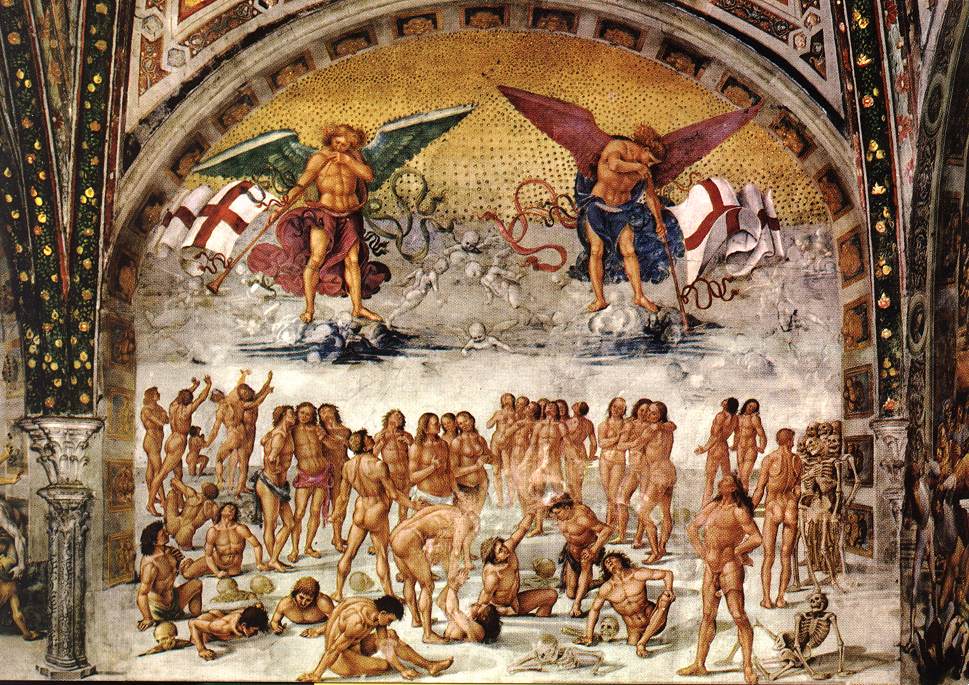
The critic Fabio Del Sole perceptively writes in The Duomo of Orvieto: “the dead emerge not from tombs, as typical in medieval tradition, but out of the bare earth. Some are not yet clothed in flesh; others are perfectly formed and vigorous. The first to be resurrected will be the elect, with new young bodies, all the same age as the resurrected Christ. To the right of the scene, animated skeletons are packed together, as though standing in the wings of a stage, waiting to be reconstituted in flesh!”
Most of Laurence Kanter’s book emphasizes the background to the paintings, and he does not precisely describe and carefully analyze the main subject: Luca Signorelli’s Virgin and Child with Saints (1498/1499). “We dance around in a ring and Suppose, but the secret sits in the middle and knows.” So there’s more to be said about this masterpiece.
The Virgin rests the delicate fingers of her right hand on the extended right arm of the naked Christ Child sitting on a high green velvet cushion. She’s dressed in a dark blue robe, a colored scarf with blue bands, a gold-banded blue bracelet, and a gold-rimmed oval brooch with a precious green sapphire surrounded by curved gold piping across her chest. The Child has a large bent head, dark skin, extended legs, heavy-lidded eyes and a rather sad old man’s expression.
The Virgin, with half-closed eyes, looks down to her right at the shaved head of St. Bernard of Clairvaux, who’s wearing the heavy pleated white robe and collar of a Cistercian monk. Bernard’s thin strand of hair runs across his ear and touches his forehead. He’s been writing a theological work on a sheaf of paper lying on a wooden table, but has no quill in his hand. An open printed book rests on a red-banded volume, and he looks up from his work to instruct the Virgin. The gesturing fingers of the Child and of Bernard are flexed and extended. In this luminous and vibrant picture even the Child, whose toes touch the open pages of the book, leans forward to absorb the spiritual lesson.
St. John the Evangelist spread the Gospel; St. Bernard and St. Anthony of Padua continued to teach Christian doctrine in the Middle Ages. The two saints stand on either side of the Virgin. The bald St. John has gold decoration on the hem of his sleeves, white hair and a long beard that touches Bernard’s left cheek. St. John and St. Anthony, who has a thick dark brown monk’s robe and heavy tonsure that circles his brow, look down with bent heads thast actually touch the Virgin. The different complexions in the four adults range from the dark St. John to the alabaster face and chest of the Virgin. The shaved and bald domes of the three saints, and the five figures who form a tender an intimate semi-circle, match the round shape and touch the top of the picture. The decorative frame of the tondo is elaborately carved and gilded, with a floral frieze that was possibly painted by Signorelli himself.
Jeffrey Meyers has published Painting and the Novel, Impressionist Quartet, biographies of Wyndham Lewis and Modigliani, and a book on the Canadian realist painter Alex Colville.

Be First to Comment