

Misguided Attempt
Jeffrey Meyers
James Van Dyke. Otto Dix: Painting and Precarity in the Field of Weimar Culture. University of Chicago Press, 2026, 288p, $55.
The poet does not number the streaks of the tulip,
or describe the different shades in the verdure of the forest.
Samuel Johnson, Rasselas
Otto Dix (1891-1969), the son of lost wars and failed revolts, was always on the warpath, swinging his brush like an axe. James Van Dyke writes that he was obsessed with “the sexual and scatological, the excessive, the erotic and the diseased.” He calls Dix “a military veteran, sex addict, iconoclastic philosopher, radical social critic and avant-garde artist; a sensual, strong-willed, radical bohemian outsider who despised academic culture, philistine tastes, the restraints of bourgeois social values, Social Democracy and the proles.” Dix, whose portraits exaggerated the physical appearance of his subjects, also painted naked female bodies, murdered women, trench warfare and mutilated soldiers.
Desperate to find a new approach to Dix, Van Dyke “argues that details in his pictures can illuminate the complex social, historical and aesthetic mediations that shape both an individual artist and a specific work. The carefully shaped protrusions and precisely positioned holes, the ironic monograms and elliptical inscriptions, the recto and verso relationships that have drawn my attention, all make the pictures in which they appear even more multi-dimensional, or polyvocal, than observers have thought.”
Van Dyke offers a series of far-fetched, unconvincing and speculative assertions, usually with a questionable proviso. A crease in the jacket of the lawyer Hugo Simons “appears to have been a sign for circumcision,” though his penis is invisible under his clothes and there’s no evidence for this wild surmise. The similar and more obvious fold beneath the beard in Saint Christopher has no sexual significance. The author doesn’t mention the more striking example, in Dix’s Self-Portrait with Jan, where the shadow beneath the baby’s penis, drooping down the shoulder of his father, makes his member appear impressively long. More important than penis envy are Simons’ bent, circling and mobile fingers, expressing the lawyer’s emotions when arguing a crucial case.
Van Dyke devotes a 48-page chapter to a tiny button or nipple that he calls a “nail protruding from the surface” of the painting. He boldly but unpersuasively claims that “this detail, once perceived and considered in context, dramatically alters the way one sees Dix’s portrayal of the Felixmüllers.” He states that Londa Felixmüller “has been nailed. This lump of paint may have functioned as a vulgar sexual innuendo or joke.” But then, it may not. There’s another similar button in Flanders that has no thematic or sexual function.
Once again, Van Dyke vainly claims the blue glass lens that the photographer Hugo Erfurth holds in his portrait “is a small, ghostly reflection of Dix looking out of the lens’ depths that reminds the attentive viewer of the painter’s ongoing presence. This barely visible reflection in the lens, once discerned, opens up the painting’s otherwise seemingly total affirmation of its subject to revision.” But Dix cannot be seen, even in the enlarged detail, which does not seem at all significant.
This book, written in a turgid, difficult-to-read style, seems to be translated from German: “His pictures, in other words, functioned reactively, dialogically or polyvocally”; “the obdurate physical ontology of paint and the instinctive or intuitive, even alchemical process of painting in the course of a critique of semiotic and art historical oversimplification.” Van Dyke combines this critical obfuscation with staggering banalities: “1926 was a complicated year for the painter. It also confronted Dix with new challenges.”
Evidently, when Van Dyke assembled his articles on Dix, his repetitions remained stubbornly in place, so this short but long-winded book includes scores of boring reiterations. He also keeps saying what he’s going to do instead of actually doing it: the aforementioned, before returning, will discuss later, will consider, the first chapter will show, this chapter will reexamine, this chapter will focus, as already noted, as I noted at the outset, I have already outlined, as I have already hinted, has already been discussed. Despite dozens of reminders` about Dix teaching at the Dresden art academy, Van Dyke never says what Dix taught and how effective he was a teacher.
More could be said about important paintings that Van Dyke woefully neglects by emphasizing distracting diminutive details. The old man’s gangrenous foot in Unequal Lovers (1925) echoes Grünewald’s Crucifixion. The prostitute’s narrow room in Sex Murder (1922), with an open window at the end and a messy bed on the left, influenced the cinematic scene in The Tin Drum (1979) when little Oskar, keenly observant but too young to have sex, is lured into a prostitute’s room.
In Three Women (1926) the tall, skinny, small-breasted girl wears an outsized bow in her unruly blond hair and makes a childish gesture with her raised left hand. The figure kneeling in the foreground, with huge presenting buttocks and pendulous breasts touching the carpet, has red lips and a mop of curly red hair reaching down to her eyebrows. The old woman seated on the left has short dark hair, a goitrous swelling on her throat, sagging balloon breasts and a bulging stomach resting on her thick thighs. The Pregnant Woman (1931) with swollen breasts and bulging stomach reprises the old woman’s appearance. These grotesque, repulsive figures ironically portray the three ages of women.
Van Dyke writes that the left half of Street Battle (1927) “is occupied by the chaotic knot of about a dozen working-class men and women, who flee, fight and fall. They are opposed by a line of five, and perhaps more, faceless soldiers or paramilitaries, who embody order violently.” But he focuses, as usual, on Dix’s tiny monogram on the back of a soldier’s grenade. The dead baby and the corpse of the slashed and bloody woman lying on the cobblestones are infinitely more significant.
The subject of Dr. Mayer-Hermann (1926) is a pudgy, oval-faced, broad-shouldered, pot-bellied, well-fed ophthalmologist. His arms and legs are spread apart as he squats on a hidden chair like a statue of a Buddha. This bearlike, scary and forbidding figure wears a white medical smock, has an optical instrument to examine the eyes attached to a white band around his forehead. The huge round mirror behind him, which reflects the unseen room in front of him, alludes to the mirrors in Jan Van Eyck’s Arnolfini Portrait and Diego Velázquez’s Las Meninas. Dix repeats this massive frontal pose with a close-up of the huge jowly head of the beer and sausage-fed actor Heinrich George (1932).
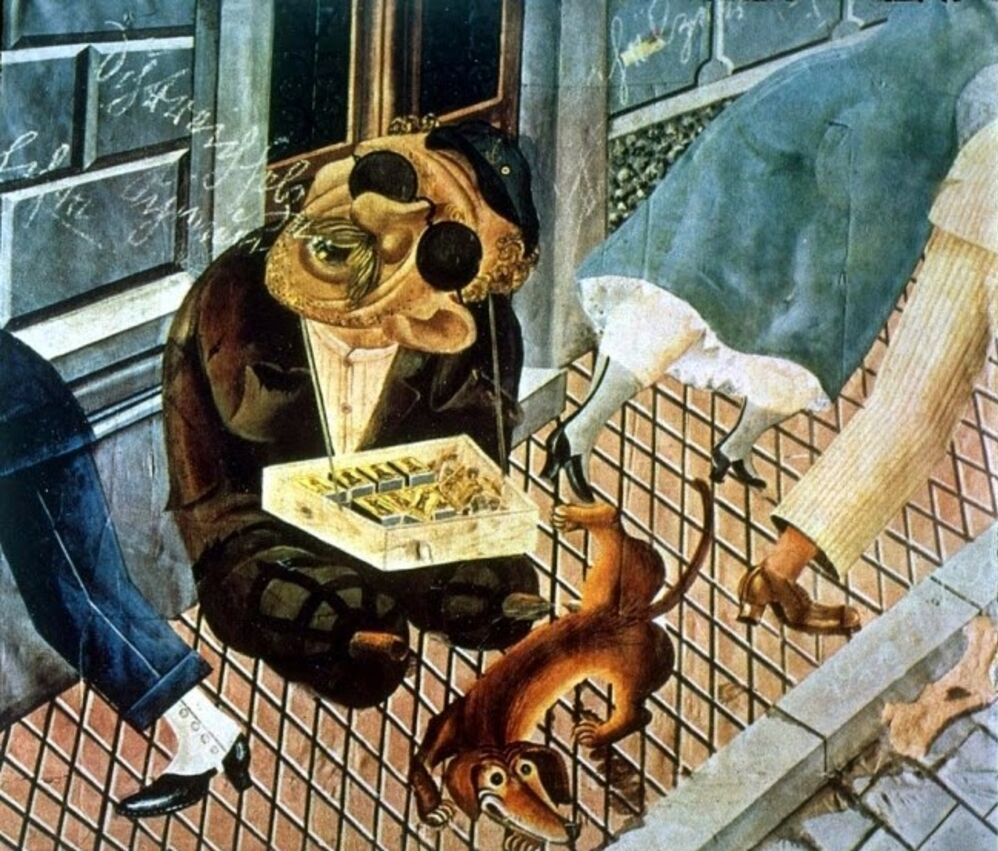
The Match Seller (1920) portrays a blind man, with his arms and legs amputated, squatting on a sidewalk made of diamond-shaped bricks. On this busy city street three well-dressed pedestrians ignore his repulsive condition, rush past him and don’t help his struggle to survive. A man’s buttoned white spat and a woman’s fluttering white petticoat contrast with the black-clothed beggar with a soldier’s cap, gigantic tilted head, furrowed brow, large dark glasses, bulbous nose, protruding wing-like ear, drooping bristly mustache and gaping nearly toothless mouth. A square yellow wooden box with a pathetic offering of matches hangs from a cord on his neck, and a wide-eyed dachshund, companion or stray, stands in front of him, also ignores him and shits on the sidewalk. Cast out of society, the blind cripple has been reduced to a wretched specimen and condemned to a subhuman existence. Dix’s humane “art as weapon” painting reveals the bitter reward given to the mutilated and humiliated veteran for his patriotic sacrifice. Dix suggests that civilian life for the soldier is just as cruel as war.
Van Dyke’s Acknowledgements exalt his “dearest friends” and “beloved comrades” who have all the angelic virtues: kindness, generosity, intelligence and wisdom. But he also, in a rare admission of academic hard times, thanks the colleagues who rescued him when he was denied tenure at Reed College, gave him a temporary job at Oberlin College and hired him at the University of Missouri when he was sliding into professional limbo. Van Dyke has published two books and lists 15 articles on Dix in his bibliography, but is still a struggling associate professor. Nevertheless, he somehow managed to capture seven grants and fellowships for this disappointing book.
Jeffrey Meyers has published Painting and the Novel, Impressionist Quartet, biographies of Wyndham Lewis and Modigliani, and a book on the Canadian realist painter Alex Colville.





Be First to Comment