
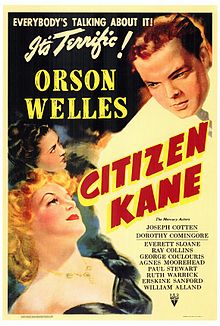
Citizen Kane (1941)
Directed by Orson Welles
By Dan Geddes
Update 4 August 2012; Originally 14 April 2001.
I venture to guess, nonetheless, that Citizen Kane will endure as a certain Griffith or Pudovkin films have “endured”—films whose historical value is undeniable but which no one cares to see again. It is too gigantic, pedantic, tedious. It is not intelligent, though it is the work of genius—in the most nocturnal and Germanic sense of that bad word. —Jorge Luis Borges
For many decades Orson Welles’ Citizen Kane was voted the “greatest movie of all time” by Sight and Sound magazine. Kane was finally knocked off its perch in the 2012 Sight and Sound list by Vertigo.
Citizen Kane isn’t the greatest movie of all time because it lacks a compelling story. Kane is a solid technical achievement, but it carries little emotional impact. We don’t care much about the characters and little is at stake for them.
Citizen Kane is based on the life of William Randolph Hearst, and much of its notoriety comes from Welles’ sheer guts in taking on one of the great media barons of the age, one whose publicity machine could make or break careers.
So often in hearing the arguments for Kane’s greatness, you hear about the novelty of its camera angles, of deep focus, of the “prismatic” non-linear narrative structure, the clever use of models and of sound. These are all interesting aspects of the movie, but we are simply never swept away by the story. If we are so conscious of watching a movie while watching Citizen Kane, it’s because we are thinking about the techniques behind it. While some have defined great cinema as cinema that draws attention to its own conventions, it still needs characters and a story we care about.
Is it really a strong story? Kane is a bio-pic, but it lacks a defining conflict (who is the antagonist?), so there is little plot development. A critic remarked of Welles’ later Othello that it was evidence that a movie is more than a series of great scenes. That criticism applies in least in part to Kane, which is nothing if not a series of great scenes (and also some not great scenes). The fact that Kane deliberately avoids straight chronology is sometimes delightful, but it doesn’t mean it builds up tension in the story either.
The movie begins with Kane’s death: we are given a resume of his work through the “News on the March” sequence (a parody of the newsreels). Then the reporter Thompson gathers five different perspectives of the great man’s life: from reading Thatcher’s memoirs, from Mr. Bernstein, from Mr. Leland, from Susan Alexander, and from Raymond (the butler).
These five characters focus on different aspects of Kane’s life: you could say Thatcher represents business, Bernstein his newspaper career, Leland friendship, Susan romantic love, and Raymond life at Xanadu. Despite this simplification, it shows the “prismatic” structure of Kane that screenwriter Herman Mankiewicz envisioned. Such a structure fits the “organic” story model (rather than standard conflict-based model). There are certainly conflicts in Kane: Charlie Kane fights with the characters representing these points of view (except the butler), as well as others.
And yet there is no central plot, no central conflict for Kane as a character. He remains distant from us, because of his money, because of his distance from the other characters, and even because the Rosebud strand (which the news editor was so sure would be the answer to everything) falls flat. It makes the point that there is no one answer to a man’s life that can be derived from his dying words, but that point could have been made earlier; the movie could still have resolved more satisfyingly.
The best scene in Citizen Kane is when Tammany Hall-style corrupt boss Jim Gettys confronts Kane, his wife, and his new mistress, Susan Alexander, in Susan’s apartment. Boss Gettys threatens to expose Kane’s affair unless Kane quits his muckraker campaign against Gettys on the eve of the election for New York governor. Kane not only rejects his offer, he even chooses to stay with Susan in her love nest that night rather than return home with his wife and child. “I’m staying here,” he says, like a petulant boy.
However, this familial tension is not sustained, as Kane’s ex-wife and son were killed in a car accident soon after (we are told during the early “News on the March” sequence). That solves a lot of problems for Kane as a protagonist, and we never see him grieve them in any way. Perhaps removing Kane’s wife from the story also made the studio and filmmakers feel safer by not suggesting that Kane (Hearst) was still cheating with Susan Alexander (the Marion Davies-type character) since Kane’s wife is dead (and apparently unmourned).
If Citizen Kane is now routinely chosen as the greatest film of all time, it has at least as much to do with the mythology of the film as the experience of watching it. The mythology of the film includes: Welles’ precocity as director (age 25 while shooting the film); the innovations of photography, greatly attributable to photographer Greg Toland; the fact that a cash offer was made by Hollywood mogul Louis B. Mayer to destroy the film’s negative; the intriguing parallels between the movie and the life of William Randolph Heart; the intriguing parallels between the movie and the life of Orson Welles; the movie’s near blackout by Hearst and lack of full national release; the Hollywood establishment’s spurning of the movie and so of Welles at Oscar time; and Welles’ subsequent degeneration and relative banishment from Hollywood despite his genius.
All of this subtext makes it impossible to watch Citizen Kane as a movie like others, like Casablanca, a movie from only two years later, also full to the rim with cinematic mythology, and yet so much more moving as a movie.
Citizen Kane is more like the canonical work of literature that you are forced to read because it is important, not because you consistently enjoy all of it. It’s ultimately a mixed bag; there are amazing scenes and some scenes that fall flat.
The “News on the March” sequence is brilliant, but the Rosebud quest that it engenders is simply silly.
What is the value of the early scene when the reporter Thompson finds a drunk, bitchy Susan Alexander at her cabaret and she sends him away? She tells her full story later.
Why is it that we don’t get to see Kane in “real time” with spoken dialog from Welles until about 25 minutes into the picture? Toward the end, instead of climaxing, the movie bores with several scenes of Susan Alexander’s terrible opera singing. We get it. How could Welles devote so much screen time to bad opera? Who wants to watch that?
None of these remarks are meant to deny the undeniable greatness of Kane, which may well be the most influential movie of all time. Kane was a powerful influence on the film noir of the forties and fifties and beyond. And the myth of Orson Welles as the author of the movie, partly inspired the dubious French auteur theory, whereby the director is conceived as the creative author of the film (rather than the producer, or the screenwriter). Kane is certainly an enjoyable film to watch, seemingly more enjoyable as you study the film’s secrets and in-jokes.
Citizen Kane itself is a work of exhibitionism by Orson Welles, a clever magician. It is a great, important work, but too weak as a story to be “the greatest movie of all time.” Vertigo has replaced it according to Sight and Sound’s voters, but many people will still refer to Citizen Kane as the greatest film of all time.
April 2001
November 2011
August 2012
Further reading
Pauline Kael, “Raising Kane”, from her collection For Keeps, (235-325). This riveting chronicle of the movie’s origins is especially notorious for Kael’s argument that Mankiewicz wrote the screenplay in seclusion, while Wells later added a few bits and took co-writing credit (and tried to secure sole screenwriting credit). While this position is now generally regarded as overstated, Kael did restore awareness of Mankiewicz.
Rosebud: The Story of Orson Welles, by David Thomson, 1996.
Roget Ebert’s “Great Movies” Citizen Kane review.
Jorge Luis Borges, Film Critic, Reviews Citizen Kane — and Gets a Response from Orson Welles by Colin Marshall, Open Culture, August 12, 2014



Be First to Comment